Three four-hour drone flights overhead over the Campeche jungle on Mexico's Yucatan Peninsula have revealed a lost city that may have been abandoned more than 1,000 years ago, a hidden "gem" below ground.
Juan Carlos Fernandez-Diaz, assistant professor of civil engineering at the University of Houston, USA, discovered this mysterious city last March during an aerial archaeological survey.
LiDAR Applications
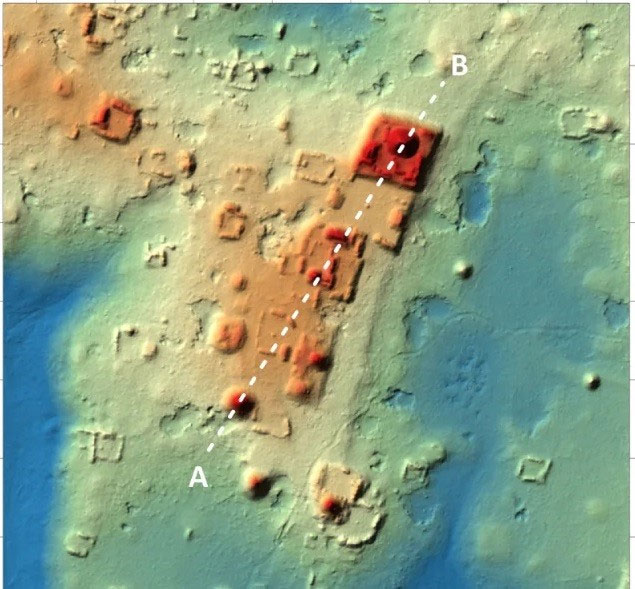
Drone photos have helped archaeologists find an ancient Mayan city buried underground more than 1,000 years ago.
Over the past decade, he has pioneered the archaeological application of LiDAR , a device that detects light in the air, and other devices that can find structures obscured by dense tree canopy and other vegetation — relics that in some cases reveal traces of a lost civilization.
Archaeologists then surveyed the site, which they named Ocomtun , for six weeks in May and June and found 15.2 m tall pyramid-like structures, pottery and carvings that they believe date from between 600 and 900 AD – known as the Late Classic period in the Maya civilization.
'When we see the (LiDAR) images, we can see there's something amazing, but the real discovery comes after a lot of investigation,' said Fernandez-Diaz, co-investigator at the National Center for Laser Mapping.
While LiDAR revealed the locations of the structures, archaeologist Ivan Šprajc — a researcher at the Slovenian Academy of Sciences and Arts (ZRC SAZU) — still encountered a major obstacle when he and his team surveyed the area.
Remote sensing technology, first used in archaeology at the turn of the century, has been revolutionary, especially for researchers working in densely forested areas that are difficult to explore on foot, such as in Central America, Šprajc says. Now archaeologists can see through vegetation.
From an aircraft or in some cases a drone, a LiDAR sensor tracks the amount of time each laser pulse takes to return and uses that information to create a three-dimensional map of the environment below.
"Special Features" of Ocomtun, the Abandoned City
The researchers had to wade through dense forest, using machetes and chainsaws to chop down trees and cut through other vegetation to reach what Šprajc described as the 'main site'.
'When we got there, we saw really massive buildings ,' he said.
The Mayan civilization is best known for its pyramid temples and impressive stone structures that have been found throughout southern Mexico, Guatemala, Belize, Honduras and El Salvador.
Šprajc and his team found three plazas complete with large buildings and a ball court. The city, he said, resembles other Maya cities from the same period, but has 'certain peculiarities', such as some very strange architectural complexes arranged in almost concentric circles, which we suspect could have been markets.
During the six-week survey, Šprajc and his colleagues conducted archaeological surveys and dug a 2m x 2m test pit, and the pottery fragments they found helped them understand the age of the site. They plan to return next year for further investigation.