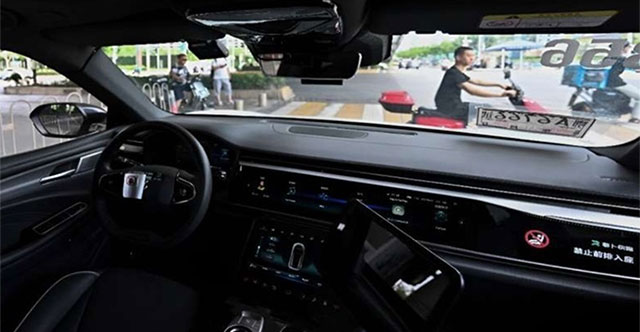
In China, you can travel nearly 10km in a self-driving taxi for only about 12-13 thousand dong.
Self-driving cars, often called robotaxis , are gaining popularity in Wuhan – a sprawling metropolis of over 11 million people in central China. The city government is ambitiously aiming to make it the world's first driverless city, even as vehicles still struggle to navigate its roads.
"You'll never have to buy a car ," a passenger said in a video that has garnered over 80 million views on the social media platform Weibo.
The fleet of 500 vehicles operating in the city belongs to Apollo Go, a service of Chinese tech giant Baidu. According to a May announcement, the company serves an area encompassing nearly 50% of Wuhan's population.
Leveraging its technological advantages and existing platform, Baidu expects this new initiative to contribute more to the development of smart transportation and autonomous vehicles in Beijing, while supporting the city in becoming a leading global AI innovation hub. Users simply access the Baidu Maps mobile app or the Apollo website, book a driverless taxi, and a few minutes later, the smart vehicle arrives.
In particular, the key lies in the price . Basic fares start at a minimum of 4 yuan (approximately 14,000 VND) , according to Global Times.
The service launched in 2022 and began attracting attention in the first half of the year. The company aims to double its fleet to 1,000 vehicles by the end of 2024. According to the city's transportation department, Wuhan currently has approximately 17,000 taxis in regular operation.
However, the rapid adoption of driverless taxis is inadvertently disrupting the workforce in the sharing economy, which is already facing a wage crisis.
"With the Chinese economy struggling, Chinese people are likely to be much more afraid of losing their jobs ," Tu Le, CEO of Sino Auto Insights, told CNN in an email interview. Any significant job losses could occur within the next few years.
Recently, the National Bureau of Statistics reported that China's gross domestic product grew by only 4.7% in the second quarter, much slower than the expected 5.1%. Residents in Wuhan also complained about traffic congestion because self-driving cars didn't respond well to traffic lights. Earlier this month, a robotic taxi even ran a red light and hit a pedestrian.
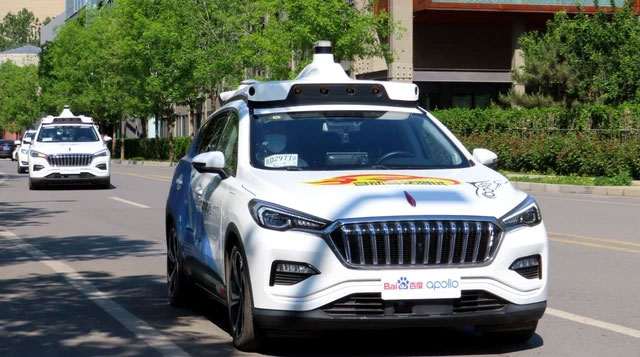
China aspires to turn Wuhan into the world's first driverless city.
The story became a hot topic of discussion. More than 75 million people shared the same concern.
"Undercutting the market is nothing. They'll steal your livelihood," one user wrote, referring to the possibility of losing your money.
"Driving schools, road inspectors, and taxis will all close," another user commented.
According to one source, company discounts and local government subsidies are often used in the initial launch phase to attract trial users with 'extremely low' prices. The minimum price of 4 yuan may therefore only be a temporary strategy.
Self-driving taxis are currently operating on a relatively small scale in a few cities around the world, primarily in the US and China. Meanwhile, the United Arab Emirates is welcoming companies worldwide to participate in trials of self-driving vehicles.
Several American companies, including Waymo, a subsidiary of parent company Alphabet, and Cruise, a subsidiary of GM, are researching autonomous ride-sharing services but have recently encountered some setbacks. Cruise's test permit in California was suspended in October 2023 after a series of serious collisions. Waymo also recently had to order a recall after two of its vehicles crashed into trailers.
According to a 2023 report by consulting firm McKinsey, China, the world's largest automotive market, could one day become the leading market for autonomous vehicles. The report predicts that this sector could generate between $300 billion and $400 billion in revenue by 2035, partly thanks to support from Beijing in deploying numerous pilot programs.
Authorities in several major Chinese cities, including Wuhan and Shenzhen, have granted commercial licenses to companies to test self-driving car services. Automakers and ride-hailing platforms are also investing in autonomous vehicle fleets.
Last week, authorities in Shanghai's Pudong New Urban Area began issuing permits to self-driving vehicle operators, including Alibaba-backed Apollo Go and Auto X. California-based startup Pony.ai, backed by Toyota and Saudi Arabia, has also been given the green light to conduct trials.
Officials in Beijing said in June they were "gathering public opinion" on regulations concerning the use of autonomous vehicles for buses, taxis, and car rental services. A draft regulation, issued earlier this month, states that autonomous vehicles must have a driver, safety personnel on board, or be remotely intercepted to ensure safety. Any traffic violations must be handled based on local laws and regulations.
Reportedly, in the southern city of Shenzhen, Apollo Go received a permit in February to conduct trials in Bao'an District. More such trials are expected across the country.
According to analysts, the progress made by Chinese companies and regulators in Beijing has posed a new challenge to the West. Raymond Tsang, an automotive technology expert at Bain, said: "It's difficult to measure, but if you look at the readiness and availability of the technology, China is probably only less than two years behind. The impetus to close the gap is enormous."
China began developing commercial self-driving cars in 2013, about five years after the US. However, as of last September, autonomous vehicles in China had traveled a total of 70 million kilometers, matching the US, according to data from Bain.
- Self-driving cars roam freely in the ghost city.
- These technologies are expected to change people's lives in the future.
- Who will the self-driving car choose to hit and who will it avoid?