Scientists highly appreciate the research value of the fossils found here.
The fossil mine is located in San Vien commune, Loc Binh district, Lang Son, Na Duong depression is the result of the sliding activity of the Cao Bang - Tien Yen fault. In addition, this is also the largest onshore brown coal basin in Vietnam with reserves of over 100 million tons. In addition to coal resources, this place also contains many valuable geological heritage resources, with unique values in paleontology, paleogeography, paleoenvironment. showing an interesting and attractive history of tectonic and geological development, attracting many scientists, domestic and foreign tourists to visit, learn and research.

Fossils of plant species found at the largest fossil mine in Southeast Asia in Vietnam. (Photo: Lang Son Geopark)
Na Duong is an exposed Tertiary sedimentary area about 33 million years ago, containing the richest fossil remains in Vietnam in particular and Southeast Asia in general.
According to the website of Lang Son Geopark, in Na Duong valley, scientists have discovered many fossils of vertebrates, invertebrates and plants that developed about 20 - 30 million years ago, many species still exist today.
According to the Vietnam Tourism Environment page, regarding plants, through research and analysis of pollen spores as well as fossils, especially leaf, stem and fruit prints, the existence of tropical and subtropical humid forests has been shown. Many resin-rich plant species grow in temperate, subtropical and tropical humid climates such as: Fagaceae (family of plants): Quercus (oak), Lauraceae (family of camphor trees), Moraceae (mulberry), Diospyros (saplings), Ficus (multi-leafed trees).

Fossilized wood trunks in Na Duong. (Photo: Lang Son Geopark).
In the coal mining area, experts also found a population of fossilized tree trunks. The tree trunks here can be up to tens of meters high.
Regarding animals, fossils found in Na Duong are very rich, including mollusks, vertebrates such as fish, turtles, crocodiles and especially fossils of mammals (anthracotheres, rhinoceroses, primates). Many species and genera have been given local names such as: freshwater snail Bacbotricula, freshwater mussels (5 species), fish (9 species), turtles (5-6 species), crocodiles (3 species, including Orientalosuchus naduongensis).
Among them, scientists discovered two new species of mammals : the rhinoceros Epiaceratherium naduongensis and the coal beast (Bakalovia Orientalis and Anthracokeryx naduongensis) ; one new species of reptile classified in a genus and a new species of turtle Pan-Trionychid , many species still alive today.

Fossil skull of Bakalovia Orientalis. (Photo: Madelaine Bohme).
Thermidons are pig-like ungulates, closely related to hippos, that live semi-aquatic lives in shallow marshes and lakes. Researchers have provided evidence and demonstrated that the mammals in the Na Yang basin were the ancestors of the rhinoceroses and thermidons of Europe. Thanks to this discovery, Na Yang became an important site in Southeast Asia for the intercontinental dispersal of mammals along the northern margin of the Tethys Ocean.
From these discoveries, scientists have sketched a panoramic picture of the ecosystem of the Na Duong basin more than 30 million years ago. Accordingly, Na Duong used to be a swamp and freshwater lake. This place developed dense forests and a rich animal world, including reptiles such as turtles, crocodiles and large animals such as cobras, rhinos. However, later, due to local flooding of Na Duong, the animals here became extinct.

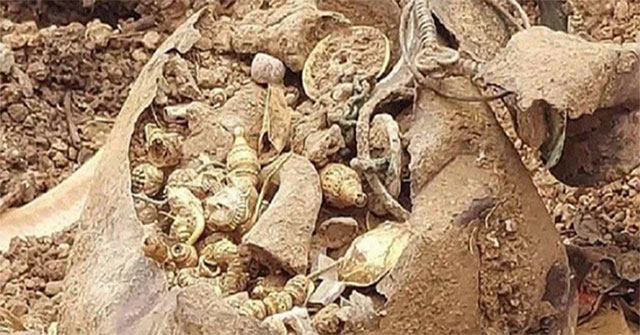
Fossilized freshwater snail shells found in the Na Duong basin. (Photo: Knowledge & Life).
To promote the historical and cultural values that the Na Duong depression brings, in the Project to build and develop Lang Son Geopark, this area was selected to coordinate landscape improvement, build infrastructure towards becoming an attractive tourist attraction and serving scientific research for tourists as well as scientists.