The traditional view of human origins since the time of Charles Darwin may be shattered by the discovery of a common ancestor in Europe.
According to Sci-News, scientists have just unearthed the 8.7 million-year-old remains of Anadoluvius turkae , a new species identified as the common ancestor of humans and several other primates.
What is shocking is that the remains were discovered in Türkiye. This completely contradicts the traditional theory that the human lineage split off from the chimpanzee family tree, evolved to the point of using tools, and then left its African homeland.
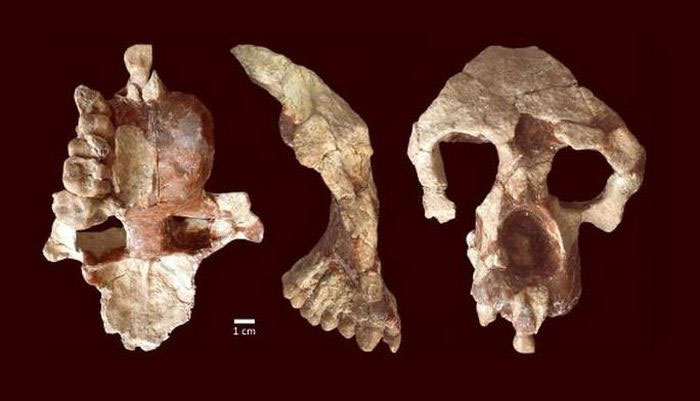
Anadoluvius turkae skull excavated in Türkiye - (Photo: Velizar Simeonovski)
The new discovery suggests that the distant history of our ancestors may have been a complex series of overlapping migrations.
Anadoluvius turkae still had an ape-like appearance, but the fossilized skull found — including most of its facial structure and the front part of its braincase — shows that it had a much larger brain than previously found ancestors.
The creature was about the size of a large male chimpanzee (about 50-60kg), lived in a dry forest environment and probably spent a lot of time on the ground.
Previously, scientists believed that the ability to move flexibly on legs, live and forage partly on the ground only developed millions of years later, with hominids already largely resembling humans.
"We don't have limb bones, but judging from the jaw and teeth, the animals found along it, and the geological indicators of the environment, Anadoluvius turkae probably lived in relatively open conditions, unlike the forest environment of great apes," said Professor David Begun, a paleoanthropologist from the University of Toronto (Canada).
The paper, published in the scientific journal Communication Biology, traces the surprising history that the remains reveal : Hominids may have spent five million years evolving in Europe before dispersing to Africa, possibly due to environmental degradation and forest loss.
The study also found that the Mediterranean ecological community - including giraffes, rhinoceroses, antelopes, zebras, elephants, hyenas, lion-like carnivores. and most recently, human ancestors - dispersed into Africa about 8 million years ago.
The authors are working to find more fossils from Europe and Africa dating back 7 to 8 million years to establish a more complete relationship.