For the first time in history, ancient footprints dating back 1.5 million years show that two ancient human species lived in the same place at the same time.
A new discovery published in the journal Science marks a major step forward in our understanding of human evolution.
It shows that ancient humans Homo erectus and Paranthropus boisei – direct ancestors and distant relatives of modern humans, respectively – actually shared habitats in the Turkana Basin, Kenya.
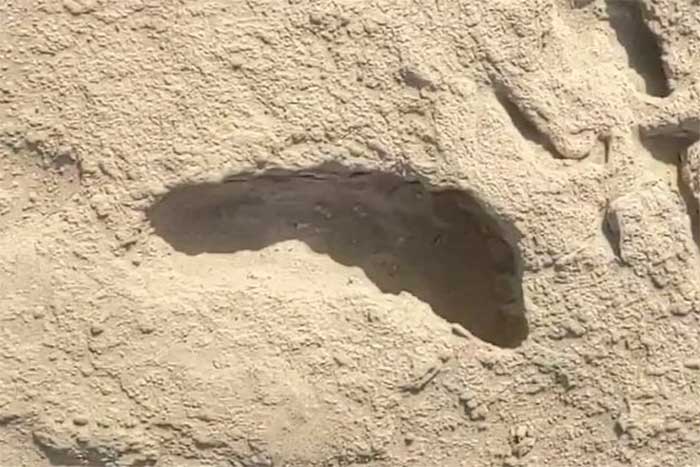
Mysterious 1.5 million-year-old footprints reveal surprising things about the relationship between two human species, Homo erectus and Paranthropus boisei (Photo: SA).
Craig Feibel, a geologist and anthropologist from Rutgers University (USA), said: "The presence of footprints on the same surface, occurring close together in time, shows that two groups of people lived close to each other on the lake's edge, in the same habitat."
Meanwhile, Kevin Hatala, a biologist from Chatham University (USA), affirmed that the footprints have provided a vivid "panoramic picture" of our ancient relatives.
'With this data, we can see how individuals lived millions of years ago, moved around, and potentially interacted with each other, or even with other animals ,' Hatala said.
In addition to providing information about the daily lives of ancient people during the Pleistocene period, the new discovery also gives us a clearer view of the evolution of human beings to walk on two legs.
Accordingly, the footprints of Homo erectus are very similar to those of modern humans. Their way of moving is also somewhat similar, when using the heel to touch the ground first, and then pushing the body forward with the toes.
Anthropologists believe that it was this walking style that enabled Homo erectus to travel greater distances than any previous species, becoming the first human species to migrate out of Africa and as far as the Far East.