The reconstructed image shows something beautiful and terrifying swimming, leading scientists to borrow the name of the alien creature in the Oscar-winning film "Dune" to name it.
According to Live Science , the special fossil was unearthed in the northern state of Utah, USA, and is an ancient sea worm .
But completely different from the "face" of modern sea worms, the reconstructed image shows a body covered with what looks like dozens of sharp, colorful knife pieces arranged all over the body.
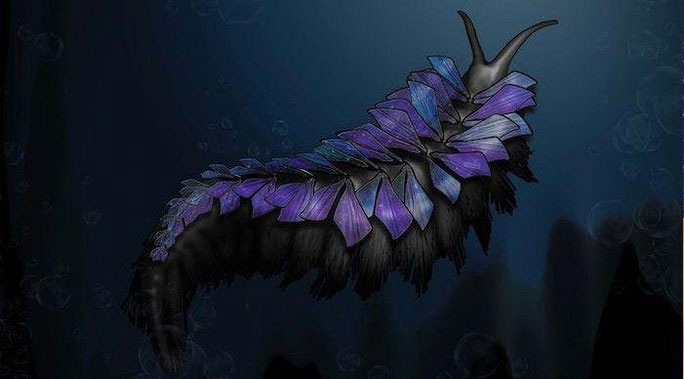
Shaihuludia shurikeni is described as an alien creature in American science fiction movies - (Graphic image: Rhiannon LaVine)
It is named Shaihuludia shurikeni, inspired by the name of the fictional alien worms "Shai-Hulud" on the sand planet Arrakis in the American film "Dune" (the Vietnamese release is called Dune: Sand Planet) which won 6 Oscars in 2022.
Additionally, shuriken was inspired by the Japanese word shuriken, the star-shaped throwing spears used by ninjas, because its bristles - the colorful bristling thing - are as sharp as the shuriken's blade.
According to lead researcher Rhiannon LaVine from the University of Kansas' Biodiversity Institute, the alien-like creature lived during the Cambrian period (541 to 485.4 million years ago), an era of explosive biodiversity that set the stage for diverse classes of organisms in later periods.
Fossils of the 7-8 cm long creature were found intact in the Spence Shale, a thick geological stratum along the border of northern Utah and southern Idaho.
"I opened this piece of stone and immediately knew it was something unusual. The first thing I saw were these radial blades that resembled stars or flowers."
The article, recently published in the journal Historical Biology, also said that this new species and its relatives are very rare specimens.
They help us "time travel" into the Cambrian period, an era when life on Earth changed forever. Scientists have not yet studied this creature in depth, but it must be a long-ago ancestor of many species in the modern world.