Something more terrible than the giant space rock Chicxulub may have existed on Earth, becoming a "death sentence" for dinosaurs before the disaster from space.
According to Science Alert, a new analysis from an international team of scientists has added to the evidence that the world before the Chicxulub impact was already a "hell", with the amount of sulfur in the atmosphere reaching critical levels.
Together with other studies of mercury levels, this research provides evidence of volcanic activity powerful enough to cause significant climate change on Earth 66 million years ago .
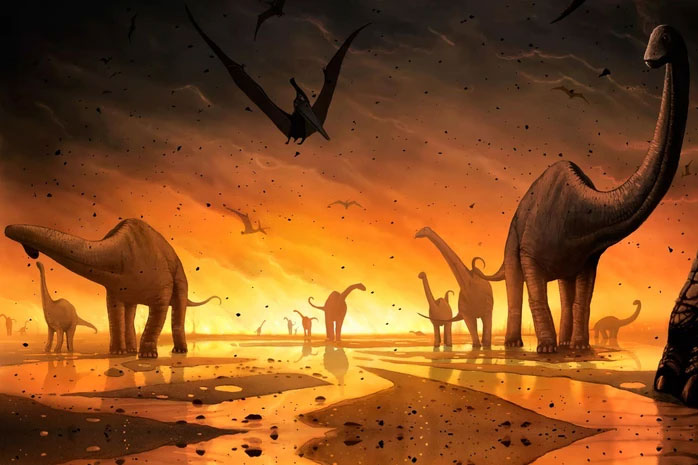
The end of the dinosaurs - (Graphic image: LIVE SCIENCE).
"Our data show that this could cause a short-term drop in global temperatures ," said geologist Sara Callegaro from the University of Oslo (Norway), lead author of the study.
This statement refers to the so-called "volcanic winter" , as a counter-reaction of the earth after a period of being turned into "hell" due to mass volcanic eruptions, a sky suffocating with sulfur and ash, blocking light from reaching the ground, combined with other climate cooling molecules, thereby strongly affecting living organisms.
The "volcanic winter" hypothesis was previously supported, but a giant meteorite - the Chicxulub asteroid - is thought to have triggered the eruption sequence.
Examining ancient rocks from the Deccan Traps volcanic region in western India, scientists measured sulfur concentrations over time, showing that emissions from this region alone were enough to change the global climate, releasing 1 million cubic kilometers of lava.
The formation of dense sulfur-containing lava here also suited the cool climate of the Cretaceous. As the lava hardened after the eruption, climate-cooling molecules were released into the air.
The chain of catastrophes caused global temperatures to plummet by 10 degrees Celsius over the 100,000 years before Chicxulub delivered the final blow.
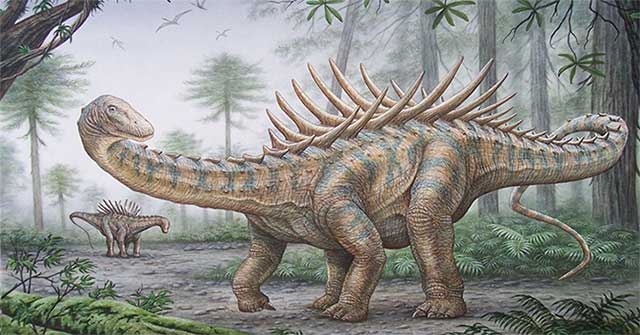
Thus, the Earth itself was the primary cause of the end of the "age of monsters ". The Chicxulub asteroid only acted as a collaborator, or even without it, climate change would have been enough to destroy the dinosaurs.
The Chicxulub asteroid is a giant space rock, believed by many studies to be the main cause of the extinction of dinosaurs 66 million years ago, at the end of the Cretaceous period.
Chicxulub was so large that it left behind an impact crater more than 180 million kilometers in diameter, extending from part of Mexico's Yucatan Peninsula to the Gulf of Mexico coast.
It is difficult to estimate the exact size of this asteroid because it broke apart after the collision, but it is certainly one of the greatest objects ever to hit Earth, in which the shock wave from the collision was enough to cause unprecedented tsunamis, earthquakes, mass volcanic eruptions.