A zoo in southern Japan has been stumped for answers to a two-year-old mystery: how did Momo, a female ape kept alone in a cage, get pregnant?
The 12-year-old white-handed gibbon lived alone and had no friends of any kind. Her neighbors obviously included a few male gibbons, but their cages were separated by sturdy bars and jagged wire fences, so the idea that Momo and another male could have crossed the two barriers to mate was quickly dismissed by zookeepers. In 2021, Momo gave birth to an as-yet-unnamed male baby with black hair and white fur neatly covering his face.
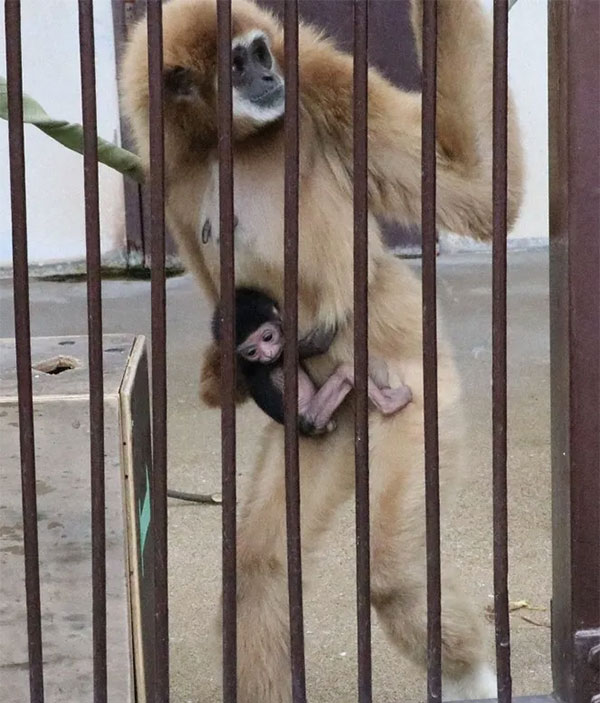
Momo and her child
The mystery has finally been solved with the help of DNA tests. Zookeepers in Nagasaki Prefecture have identified the baby gibbon's father and also found out how his parents met.
After asking a researcher to conduct a DNA analysis of fecal and hair samples collected last year from six individual gibbons: Momo and her baby, and four potential male gibbons in the race to 'father the child' , Kujukushima Zoo and Botanical Garden announced on Tuesday the identity of the father: Itoh - a 34-year-old agile gibbon.
' It took us two years to solve this mystery, simply because we couldn't easily get close enough to collect DNA samples - Momo is very protective of her cubs ,' said zoo director Jun Yamano.
The father ape has been identified, but an equally vexing question remains: if Momo never had direct contact with Itoh, how did she get pregnant in the first place?
The zoo doesn't have hard evidence like surveillance footage, but Yamano speculates that the point of contact between the two apes was probably a hole in the wall measuring just 9mm in diameter.
At the zoo, Momo and Itoh take turns performing in front of visitors in the morning and afternoon in the same exhibit area located directly in front of Momo's cage; the two spaces are separated only by a partition - a perforated board - intended to prevent the apes from getting close to each other.
But, if you don't want to, you will find an excuse, and if you want to, you will find a way.
' We think it's very likely that on one of the days that Itoh was kept in the exhibition area, he and Momo mated, through one of the holes in the partition ,' Yamano said.
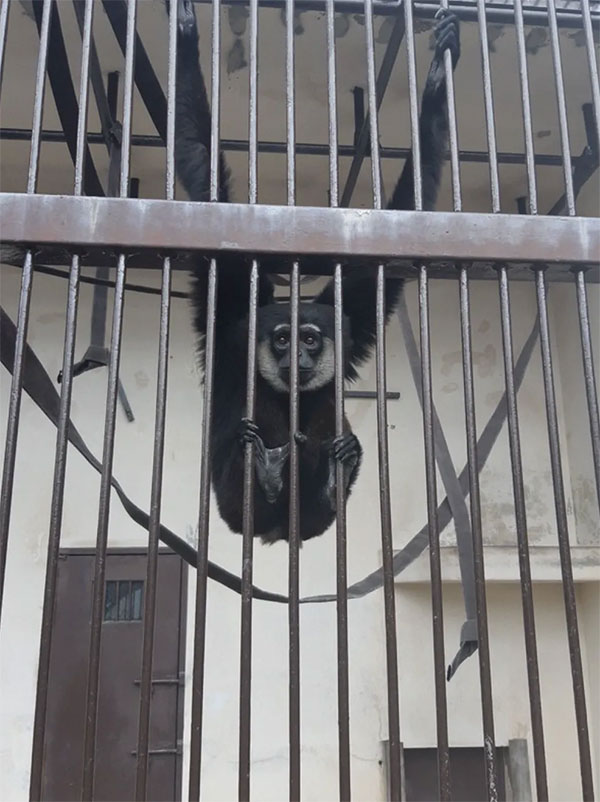
And Itoh, the baby's father
Such mating habits have never been documented before, Yamano said. Normally, zoos pair gibbons after a lot of trial and error to get them used to each other and actually feel close to each other.
In the wild, apes select mates based on physical appearance, social behavior, and vocal cues, such as through the complex songs they produce. The zoo has not revealed how, if at all, Itoh wooed Momo.
Since the mystery was solved, Yamano said the zoo hopes to move Itoh to live with Momo and their cubs.
' The three will have to get used to each other first, but hopefully they will live together as a family ,' said the zoo director.
To prevent a similar incident from happening again, the zoo has now replaced the perforated board with a barrier that has absolutely no gaps, Yamano added.