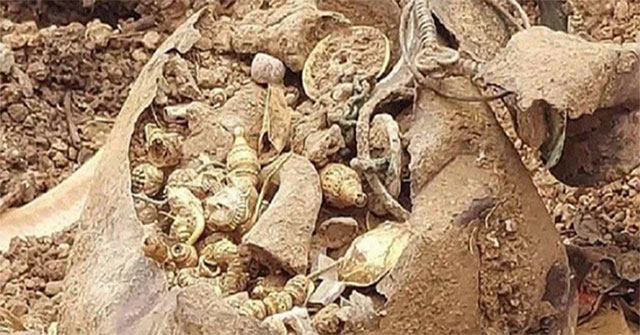
A sand mine in Ecuador has unearthed the first amber in South America containing biological elements, including spider webs and a collection of mosquitoes, beetles, flies, wasps and black flies that lived 112 million years ago.
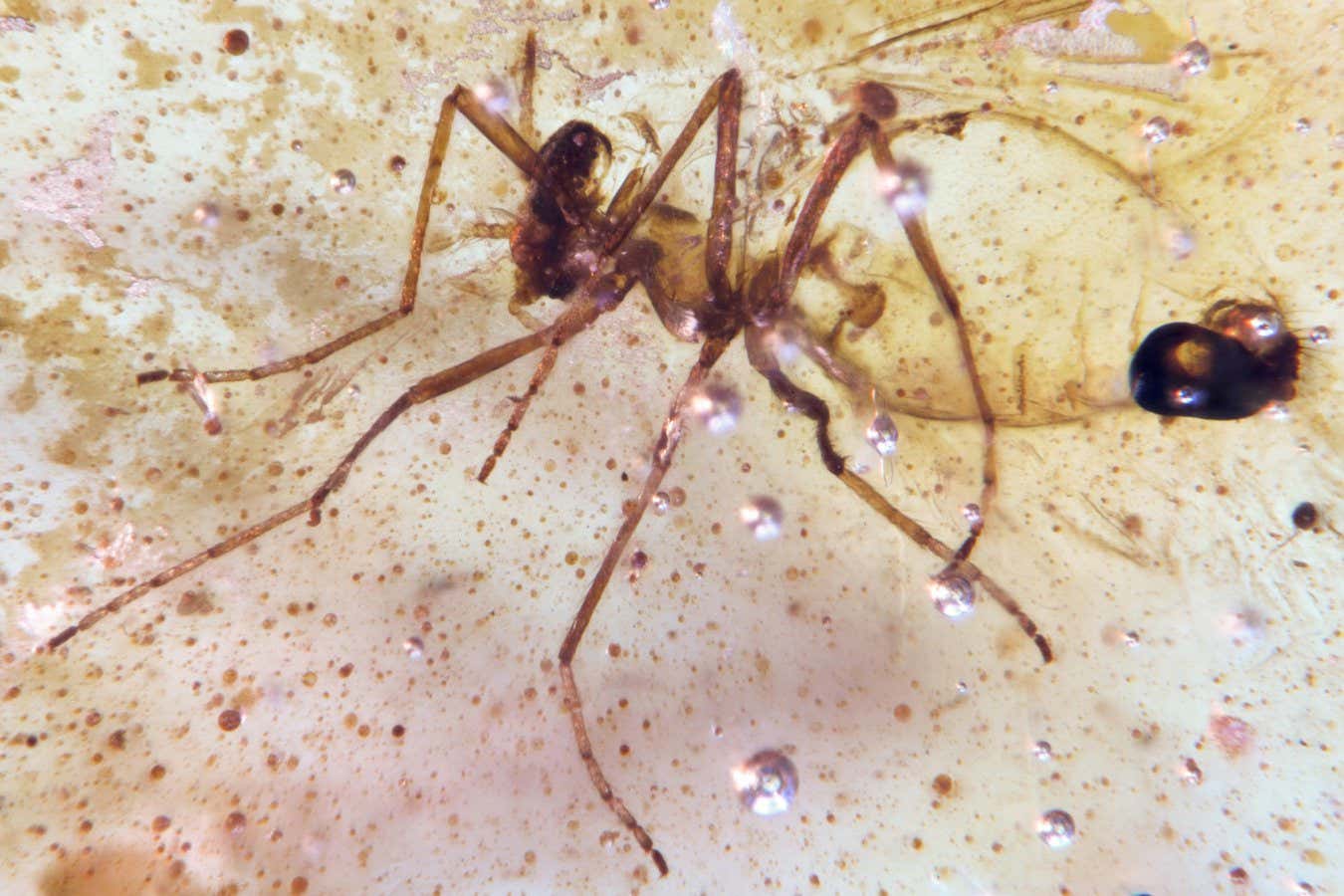 A non-biting mosquito trapped in amber was found in Ecuador (Mónica Solórzano-Kraemer)
A host of perfectly preserved insects and even a spider web encased in 112 million-year-old amber have been found in a quarry in the Amazon rainforest.
Xavier Delclòs at the University of Barcelona, Spain, and his colleagues heard that amber – fossilized tree resin – had been mined from the Genoveva quarry, in the Oriente Basin, eastern Ecuador, and traveled there in 2022 to see for themselves.
The amber at the site is thought to have come from the resin of conifers of the Araucaria family, which covered the area when present-day Ecuador was still part of the supercontinent Gondwana.
Amber deposits come from two main sources: the above-ground parts of trees and their roots. The above-ground parts sometimes contain the remains of insects and other life forms that become trapped in the resin, which later turns into amber. These preserved remains are called biofouling.
Most of the amber found at the quarry comes from underground sources, but during preliminary excavations at the site, the team collected 60 promising aboveground amber blocks and brought them back to the lab for preparation and study.
More than a third of these contained biological inclusions such as insects, plant parts and even spider webs dating from the Cretaceous period, part of the Mosazoic period. 'This is the first time that [Mesozoic] amber with biological inclusions of insects and spiders has been found in all of South America, and they are definitely new species, ' says Delclòs.
Insects included various types of flies, as well as wasps, mosquitoes, beetles, and gnats, all of which lived alongside the dinosaurs in a humid forest near the equator. Some species depended on water to complete their life cycles, so lakes, rivers, and swamps were probably abundant.
 A polypore mushroom beetle trapped in amber found in Ecuador (Enrique Peñalver)
If someone visited the site at the time, Delclòs says, they would definitely need insect repellent. 'And probably some way to escape a carnivorous dinosaur or two,' he says.
'There are some species of mosquitoes that feed on blood, and this suggests that at some point in their life cycle they would have needed the blood of vertebrates, be it avian or non-avian dinosaurs.'
However, any dinosaur DNA that was once present in the blood of the mosquitoes preserved in amber has long since been destroyed, most likely by chemicals in the resin. 'We cannot create a Jurassic Park from Cretaceous amber, at least with current techniques,' Delclòs says.