
Space science
About to build the world's largest telescope
Scientists from Southern Observatory (Europe) announced that they are about to build the world's largest telescope with a diameter of 42m with an estimated cost of $ 1.4…
Browse ScienceInfo articles and explainers related to Telescope.
1,099 published items.
Scientists from Southern Observatory (Europe) announced that they are about to build the world's largest telescope with a diameter of 42m with an estimated cost of $ 1.4…

In 2014, James Webb Space Telescope will be launched into space, the great career succession of the Hubble Space Telescope has reached retirement age.

A series of new photos sent back to Earth by the Hubble Space Telescope showed the color of Pluto changing and the ice blocks on its surface moving.

The UK's leading astronomer claims the opportunity to find creatures in the universe is growing thanks to the tremendous development of technology.

The photos of the amateur universe received good appreciation from astronomers, Peter Shah shared that the window toward the universe is always open to you, even with th…

Based on an image taken by the Hubble Space Telescope, scientists believe that collisions in the universe are no longer hypotheses.

An official of the US Aeronautics Agency (NASA) and many other astronomers insist they will find a planet with life in four or five years.

American and international astronomers have discovered planetary systems forming in the universe, about 1,500 light-years from Earth.

Observing their planets and moons, can help people find new settlements like Pandora in the blockbuster Avatar recently released.

The Kepler Space Telescope of America has found five extrasolar planets whose surface temperatures are greater than boiling lava.

After 15 years of service in space, two devices WFPC-2 and Costar were removed by astronauts in May 2009.

NASA's Wide-field Infrared Survey Explorer (WISE) telescope lets you see stars close to the solar system, which were previously invisible to us.

Chilean and Japanese astronomers claim to have for the first time seen part of the cosmic grid of galaxies about 7 billion light-years from Earth.

Combining images taken from multiple space telescopes, scientists introduced the beauty of the center of the Milky Way, the galaxy containing the Earth.
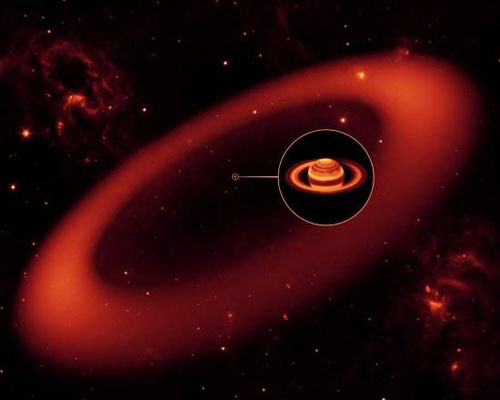
The record-breaking and unprecedented giant belt discovered by Spitzer telescope. The half-dark mystery of the moon Iapetus had the answer.