When the shipyard began to shake, the workers were afraid to die. Is there an earthquake? The jetty squeaked to the side. Trucks and boxes crashed down to San Francisco Bay .
Then the big pillars of the pier broke in two, planks and hulls cried as they sank into the sea. Finally, the house of customs fell into the foaming water. In the autumn of 1920, many buildings built on wooden pillars shared the same fate with the Benicia shipyard. Almost every week there is a collapsed bridge or house. San Francisco Bay is like being devastated by a storm.
City Council hastily summoned many engineers and experts. They quickly found the cause: Many whitewashed walkways penetrated into the wooden pillar until the core. The wood was broken into, losing half its weight. The trunk was so soft that one could stab a knife deep into it. The image of the damage was obvious: San Francisco experienced the most intense wood-eating problem until that time. It was not until the summer of 1921 that they began to fade.
Earlier, when building a jetty in the San Francisco Bay Area, it was considered an ideal location because the water here was too sweet for the species Bankia setacea. But they didn't count Bankia's cousin, Teredo navalis.
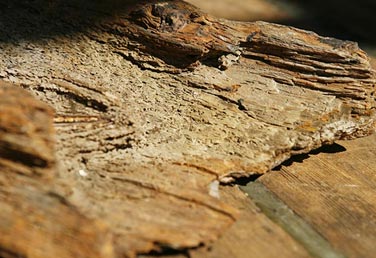
Wood has been penetrated by the galaxy.(Photo: AP)
Teredo navalis is a tramp around the world and is also the most devastating of all species. They look like worms but belong to the bivalve layer. The two shells shrank into two small and hard pieces on the head, which were used to dig one millimeter into the wood like a tiny drill. It can live in warm tropical waters and in the cold North Sea. It is resistant to Mediterranean saline water as well as to brackish water of the Baltic Sea. Nobody knows exactly where it comes from. Perhaps it was a passenger stowing a ticket, hiding in the hull to travel the world over the centuries.
More destructive than pirates
Since people built wooden piers and boats, sea termites destroyed them; and perhaps they have sunk more boats than all the naval admirals and pirates combined. It is thought that Columbus lost many ships at the same time in his fleet because no one realized they had been penetrated by the galaxy. In 1731, a riddled port was broken in the Netherlands during a flood and storm: Hundreds of people drowned. In 1922 the "New York Tines" reported on "the war against the galaxy" , and in 1980 it was necessary to repair many jetties at the Hudson River - costing $ 100 million.
These animals also operate in Germany's North Sea coast until today. Almost always because Teredo was cloudy. Of course, seafarers have also developed many countermeasures. It is thought that the Egyptians swept their boat with a protective layer of plastic trees and the Chinese built two layers of ships, in the middle is a layer of goat skin to counteract the attacks of the galaxy. About 100 years ago, people began to spread creosote on wood, a mixture of chemical compounds distilled from coal tar. But this toxic mixture not only kills the galaxy but also other shellfish nearby. It has been banned for a long time.
Sometimes they disappear over decades
The reason why Teredo and its relatives often crashed into people as a natural disaster despite the many sophisticated preventive measures that are in their unpredictability. Sometimes they disappear for decades - perhaps because of inappropriate salt and temperature. Those who forget them and start using untreated wood will have nothing in their hands to fight.
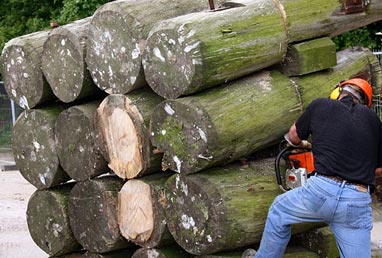
Wood piles are used to force the boat to be stocked and eaten.(Photo: DPA)
Therefore, in 1993, the staff of the Department of Environment and Nature (StAUN) in Rstock City (Germany) had to stand helplessly watching Teredo navalis eat through the protection dike at the coast of Mecklenburg-Vorpommern state. . The destruction was terrible, they destroyed more than two-thirds of the 1100 dikes. So far, the replacement of old pine dike piles has cost 20 million euros.
The most dangerous Teredo when he was small
Teredo has invaded wood since childhood, leaving only a small pin-like hole. So it is not surprising that Columbus did not recognize the banquet taking place in the shells of his ships.
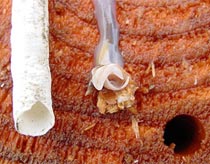
Lime tube, "drill head" with soft body and a drill hole of the galaxy Teredo navalis. (Photo: Bewuchs-Atlas)
For Kai Hoppe biologist, Teredo is a fascinating creature, "simply because it has so many biological tricks." For example, two lime buttons that it uses to close two holes. When the outside is uncomfortable, the worm retrieves the two vents and closes the door. Teredo tight-fitting covers can live dry for up to 3 weeks. It changes to anaerobic life, a way of metabolism without oxygen.
And how to reproduce it too! Ha is a hermaphrodite species, which in turn experiences male and female periods. They mature very quickly.
Archaeologist Harald Lübke does not share his interest in the galaxy. Over the years he has studied archaeological findings on the seabed of the Baltic Sea. His conclusions: No matter how old the wood is, Teredo eats everything that emerges from the sediment - the new logwood body, the Stone Age lance or the 6000 year old trees that flow of water The bottom of the sea reveals. In this case, the archaeologist must be faster than the galaxy. He also rushed to load many historical timber trucks from the Baltic Sea and soak them temporarily in a lake just to let Teredo not dig in. This creature died after a few days in fresh water.