Scolopendra gigantea (also known as the Peruvian giant yellow-footed centipede or the Amazon giant centipede) is the largest representative of the genus Scolopendra in particular and the centipedes in general, their average size is about 26 cm. Arthropods use venom to paralyze prey, then devour them.
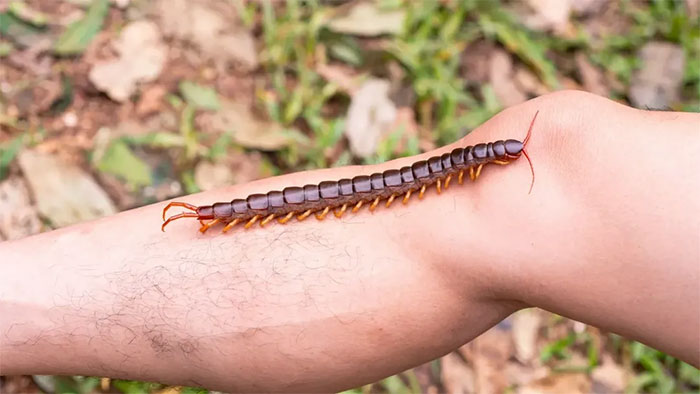
Its long, flattened body has 27 segments, with 21 pairs of legs. The first pair of legs act like fangs, used to stab and inject venom into the body of prey.
The giant centipede can be found in northern Colombia and northern Venezuela, as well as the nearby islands of Aruba, Curaçao and Trinidad. However, its ancestors come from the US Virgin Islands, Haiti, Mexico and Honduras. Their ideal habitat is usually under the wood, bark and in the leaves of tropical forests.
They can sometimes be found in caves. To learn more about this creature, Newsweek spoke with Greg Edgecombe, a centipede expert.
For arthropods, Scolopendra gigantea is considered king in terms of size. Most of the specimens found in many museums are between 12cm and 26cm long, however, individuals up to 30cm long have been found that can eat mice and lizards.
With such a huge size, this insect is capable of killing and eating small mammals. According to Edgecombe, centipedes are omnivores, they hunt based on the size of their target, they can even eat smaller centipedes.
'Perhaps the most famous report on Scolopendra gigantea is the transcript and videotape from a limestone cave in Venezuela published in 2005,' the expert said.

A white-legged Scolopendra gigantea.
The video shows scolopendra gigantea crawling up the cave wall, hanging upside down, using its last pair of legs to cling to an opening in the ceiling, then capturing and killing at least three species of bats living in the cave. These bats are of course heavier than centipedes.
Centipedes can kill their prey by injecting venom into their bodies. "The centipedes have venom glands located in a modified pair of legs below the head. The neurovenom from their legs can mess with the cardiovascular, respiratory and nervous systems, eventually," says Edgecombe. kill the prey'.
'The fact that they have killed and eaten many vertebrates, and from what we know about the venom of other large Scolopendra species, a bite from Scolopendra gigantea would certainly be painful for humans. Giant centipede bites are very rarely fatal, but pain can be intense and local swelling is common,' Edgecombe said.
There was only one confirmed death from a centipede bite. In 2014, a child in Venezuela was bitten by a centipede that was hiding in an empty soda can. The child was taken to the hospital immediately, but his condition rapidly deteriorated, followed by death. Researchers confirmed the culprit was Scolopendra gigantea.
Edgecombe says that Scolopendra gigantea is a typical "New World Scolopendra". This means that the North and South American Scolopendra species share 'several features, which suggest that they are closely related and form the same natural evolutionary unit'.
"All of them have a curved groove on the first body segment parallel to the posterior border of the head. In addition, they also have clusters of spines on the segments of the hind legs that we did not see on the older Scolopendra. Scolopendra gigantea shares many characteristics with other large species from South America and the Galápagos Islands, such as Scolopendra galapagoensis,' Edgecombe said.