In Vietnam, there is a species of snake known by the nickname "Queen of the Night". Although this is only a species of water snake, it possesses extremely dangerous venom and is capable of causing death.
Snakes are considered "queen of the night" in Vietnam.
The snake mentioned above is the red-necked water snake , scientifically named Rhabdophis subminiatus , a species of snake belonging to the genus Rhabdophis, family of water snakes.
In Vietnam, this snake is known by many names such as red-necked water snake, flat-necked snake, red-necked pheasant snake . of which the most widely known are the queen of the night, fire tiger and student snake.
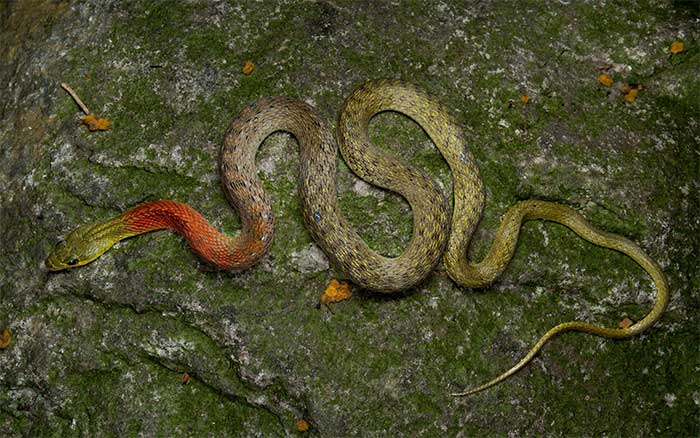
The red-necked grass snake stands out with its red neck, which is also the origin of the snake's name (Photo: GBIF).
The red-necked grass snake is a medium-sized species, with a body length of only 0.8 to 1 meter, with females being much larger than males. The head and neck are clearly distinct. This snake species usually has a blue-black or dark gray body, a dark head, and the front half of the body often has black stripes. Young snakes often have a very clear yellow or black neck ring, but these rings will fade as the snake matures.
The most prominent feature of the red-necked grass snake is that its neck has a very prominent red scale, making this snake very easy to identify. This feature is also the reason for the name red-necked grass snake or student snake because it reminds many people of the red scarf of a student.
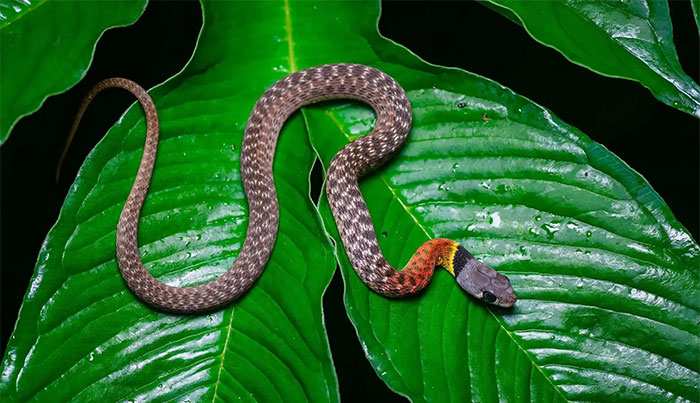
Juvenile red-necked grass snakes will have yellow and black rings on their necks. These rings will fade as the snake matures (Photo: Animalia).
Red-necked snake is a species of snake widely distributed in Southeast Asian countries and China.
In Vietnam, this snake species is widely distributed in almost all provinces and cities , with 2 subspecies, including Siamese red-necked grass and He-le red-necked grass (or Northern red-necked grass) . Of which, He-le red-necked grass lives in the Northern region and the North Central region, while Siamese red-necked grass is distributed in the South Central region and the Southern provinces.
The red-necked snake is a semi-aquatic snake , often living in areas near water such as rice fields, ponds, lakes, rivers, slow-flowing streams, dams. This snake species also appears in residential areas, so it often clashes with humans.
This is a diurnal snake and spends most of the day hunting. Its main food is frogs, toads, fish, etc.
How poisonous is the red-necked grass snake?
As mentioned above, the red-necked grass belongs to the water snake family , which makes many people think that this is a non-venomous snake. However, in fact, the red-necked grass possesses dangerous venom that can be fatal.
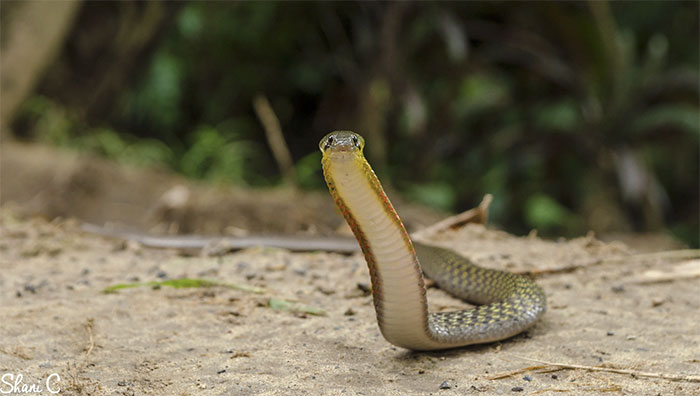
The red-necked grass snake can raise its head high and spread its neck to intimidate predators (Photo: Shani Cohen).
The Red-Necked Snake is a docile snake that always tries to hide when faced with humans. When threatened or agitated, the Red-Necked Snake can raise its head, flatten its neck, and curl its body into an "S" shape, ready to strike to intimidate its enemies.
The red-throated snake is a posterior-fanged species, meaning that its venom-injecting fangs are located deep inside the upper jaw, near the throat, instead of just outside the jaw like most other venomous snakes.
Due to the deep position of the fangs, red-necked snakes in particular and other hind-fanged snakes in general often have to bite deeply into their prey or enemies to put their fangs in the right position to be able to inject venom. This makes the venom injection of hind-fanged snakes less effective than that of front-fanged snakes.

Types of fangs of venomous snakes (from left to right): posterior fangs, fixed anterior fangs and folded fangs (Photo: SA).
Because of the design of the venomous fangs located deep inside, the red-necked cobra usually only delivers a dry bite without injecting venom. This is what makes many people mistakenly think that the red-necked cobra is a harmless and non-venomous snake.
However, if bitten by a red-necked cobra in areas such as between fingers, toes, or on children's hands and feet (small areas that are easily bitten deeply by snakes), the victim can be bitten by the cobra's fangs and become poisoned.
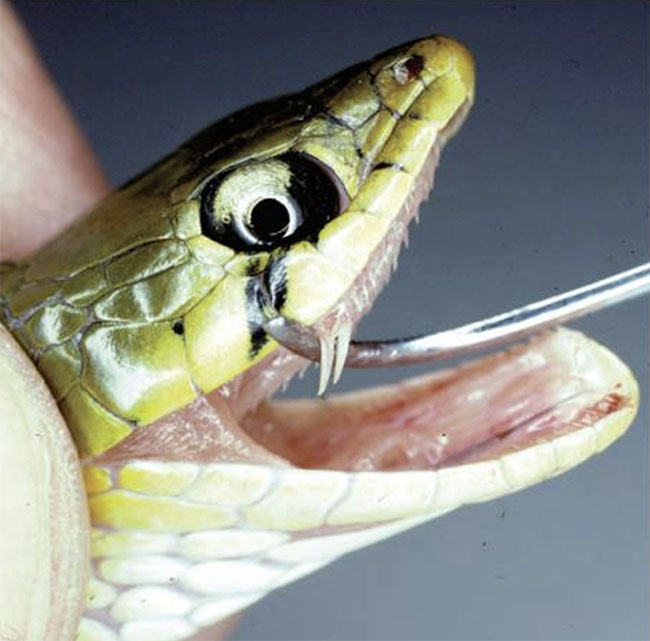
The venomous fangs of the red-necked grass snake are located deep inside the jaw and are rarely used (Photo: Mahidol).
Currently, no specific serum has been developed for the venom of the red-necked cobra. The main reason is that the cobra is a docile species, has posterior fangs and rarely injects venom when biting, so research on serum is not really necessary. However, if poisoned by the red-necked cobra, the victim can be fatal.
If bitten by a red-necked cobra, the victim should be taken to the nearest medical facility immediately. Although there is no antivenom available, doctors can treat the patient based on symptoms to help prevent poisoning.
The second poison gland is located in the red neck.
A special thing about the red-necked grass snake is that they not only possess venom glands to inject into enemies through their fangs, but this snake also possesses a venom gland located in the red neck part of its body.
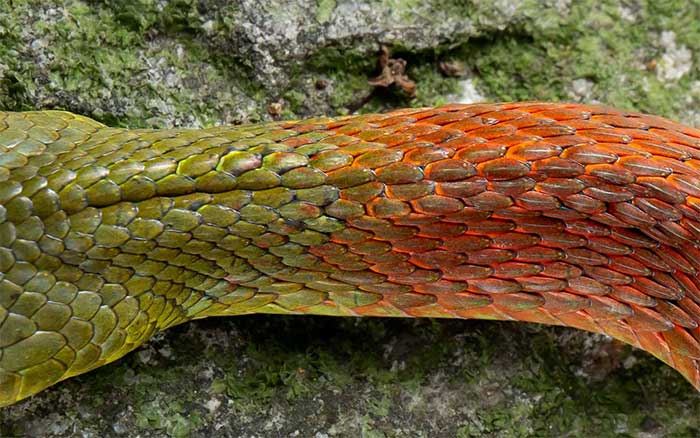
The red scales on the neck of this snake are capable of secreting poison, which can be dangerous to humans if swallowed or comes into contact with the eyes (Photo: HKSnakeID).
When threatened or in danger, this snake can secrete venom from its red neck by rupturing poison glands under its skin. The venom is accumulated in the red neck grass from toads, the snake's favorite prey. The venom from this snake's neck can be dangerous if accidentally swallowed or comes into contact with the eyes.
Therefore, if you encounter a red-necked grass snake, you should just chase it away, instead of trying to capture or destroy this snake to avoid the risk of being poisoned by the venom glands on its neck.
Fatal misunderstandings and unfortunate accidents with red-necked grass snakes
Many people mistakenly believe that the red-necked grass snake is a harmless water snake, so they capture and keep this snake as a pet. This fatal mistake has led to unfortunate accidents.
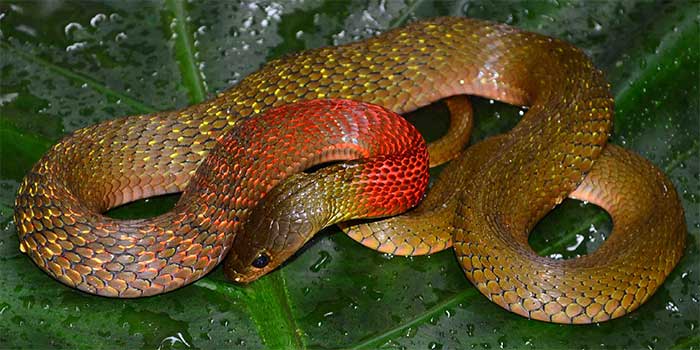
The red-necked grass snake has bright and eye-catching colors, but it is absolutely not allowed to keep this snake as a pet to avoid unfortunate accidents that may occur (Photo: Biodiversity).
For example, in 2021, a 3-year-old boy in Ho Chi Minh City was bitten on the hand by a red-necked cobra, leading to his death. Previously, the boy's grandfather had raised a red-necked cobra, thinking it was a harmless snake, but in the end, the boy was bitten on the back of his hand, leading to his death.
There have been many cases where people have played with and captured red-necked grass snakes because they thought they were harmless and gentle snakes. This has led to the risk of being bitten by red-necked grass snakes, which can lead to death.
With the information provided in this article, we hope that people will be more vigilant when encountering the red-necked grass snake, and limit contact with this snake to avoid being bitten or being infected with the poison secreted from its red neck.