The Air-Shield device creates a downward airflow that helps block liquid droplets containing nCoV from being sprayed from patients during treatment.
The Design-Technology Lab at the Technion-Israel Institute of Technology and Rambam Hospital have developed an innovative device for healthcare workers called the Air-Shield. The device continuously blows air into the wearer's face, increasing protection against infectious diseases while preventing fogging and overheating of the goggles.
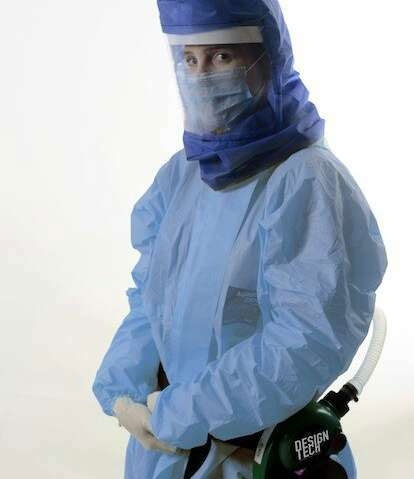
Air-Shield device helps protect medical staff. (Photo: Phys.org).
Professor Ezri Tarazi, chair of the Industrial Design Program and director of the Design-Technology Lab, worked with doctors at the Rambam Hospital Clinical Research Institute to create a device that improves the effectiveness of protective masks used by healthcare workers treating Covid-19 patients. Body heat often causes condensation inside protective suits, fogging up the face shields and making it difficult for healthcare workers to see clearly. In addition, some current masks may not be effective enough to block infection from droplets containing the virus.
"When a medical team is taking care of a Covid-19 patient, if one medical staff member is infected, everyone in the team must be quarantined. Therefore, protecting the whole team is the top priority," Professor Tarazi emphasized.
According to Dr. Ronen Zalts, who first tested the device in the Rambam Hospital's coronavirus department, and Professor Tarazi, the Air-Shield creates a downward airflow from the forehead, providing an "air shield" inside the mask, separating the doctor from the surrounding air, which may contain droplets carrying pathogens. A small pump at the waist directs the air through a tube to the forehead and releases it through small holes in the folds attached to the mask. "We tested several different prototypes and made some adjustments to improve the design and optimize the performance," said Dr. Asaf Miller, head of the Rambam Hospital's intensive care unit.
Professor David Greenblatt of the Technion's Department of Mechanical Engineering tested the air flow repeatedly to ensure uniformity. Although the N95 masks used by healthcare workers provide 95% protection, the team sought to improve their effectiveness. Professor Tarazi took the design of the Air-Shield from the pumps used in gas masks used in nuclear, biological and chemical warfare, and adapted it to the needs of healthcare workers, including incorporating thin, flexible tubing, ultra-light pleats, a thin shield and a rechargeable battery.