Africa has recorded just one coronavirus patient, which experts say is due to climate, luck and possibly testing.
Africa is home to more than 2 million Chinese people, many of whom return home for the Lunar New Year and then return.
Before the Covid-19 outbreak began in Wuhan, Hubei Province, Africa received about eight flights from China a day. Tourists often traveled in large groups using Ethiopian Airlines, the country's largest airline. Since the outbreak began and spread around the world, Africa has remained largely immune.

Africa is currently less affected by Covid-19. (Photo: AP).
World health experts have a very simple explanation. It is possible that the health system here has not yet found positive cases . As of mid-February, only two African countries, Senegal and South Africa, have laboratories capable of detecting the virus.
"We don't know if there have been any cases of the new coronavirus. It's possible that some people have been infected but have not been detected," said Isaac Ngere, an infectious disease expert in Kenya.
Last week, medical teams from more than 10 countries met in Senegal to learn about how to diagnose nCoV. According to the World Health Organization (WHO) in Africa, 19 countries including Nigeria, Gabon, Cameroon, Ethiopia, Kenya, Zambia and Sierra Leone can now test for nCoV themselves.
WHO has also identified 13 countries with close ties to China. They said they have sent experts to eight countries to coordinate preparations to contain the outbreak.
In Sierra Leone, more than 30 Chinese nationals who entered the country last week were quarantined in Freetown.
"Anyone, whether they are Chinese, Sierra Leonean or Nigerian diplomats, as long as their passport shows they have left China within the past 14 days, we will hold them and quarantine them as soon as they cross the border," said Dr. Mohamed Alex Vandy, director of the city's Emergency Health Security Management Agency.
"It's not because they are infected or have committed a crime. This is a precautionary measure to ensure the safety of citizens ," he added.
According to Mr. Isaac Ngere, with screening and on-site testing capabilities, the continent may soon record cases of corona infection.
Meanwhile, Paul Hunter, an infectious disease and epidemic expert in the UK, said the "absence" of nCoV in Africa was largely due to luck .
"If you look at how Covid-19 has spread to countries outside of China, it depends a lot on travel density. The fact that Africa has not recorded any positive cases is not something special, it is just luck," he said.
Another hypothesis is that Covid-19 cannot thrive because Africa is too warm .
nCoV belongs to the coronavirus family, which includes some strains of the virus that cause the common cold and flu — seasonal illnesses that peak at certain times and wane over time.
Many strains of flu peak in the winter, when the air is cold and dry and droplets from sneezes are more easily spread through the air. The virus dies off as the weather warms.
"When the climate is warmer and more humid, the droplets (containing the virus) tend to fall out of the air faster, so transmission is limited," said Yap Boum, Africa representative of Doctors Without Borders.
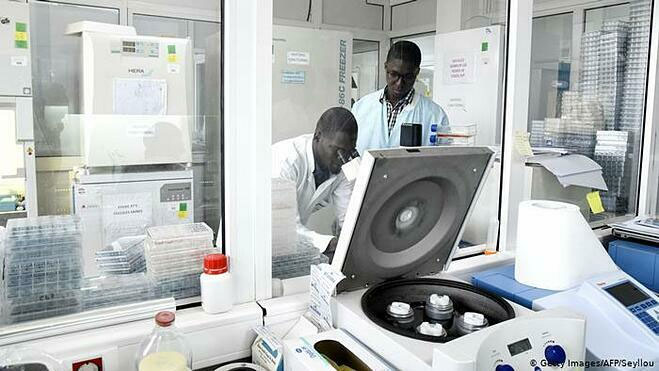
Currently, only two countries in Africa have laboratories capable of testing for nCoV. (Photo: AFP)
However, not all coronaviruses are transmitted through droplets. Mr Boum cautioned that it was too early to draw definitive conclusions about the transmission of Covid-19. "It would be wise for African countries, which are entering winter, to use this time to monitor the impact of weather on the coronavirus," he said.
Epidemiologist Paul Hunter stressed that the Covid-19 outbreak 'has not been around long enough' to study seasonal changes in the virus. But even if there is a possibility of an outbreak in Africa, he said the region is unlikely to be hit as hard as China.
'Droplet-borne diseases are not usually a big problem in Africa ,' he said. That was the case during the 2003 SARS outbreak, which spread to 26 countries, killing nearly 800 people, but had little impact on the continent.
In addition, Africans do not tend to live in densely populated areas. They also spend more time outdoors than most northern countries.
Rumors have been circulating on social media platforms that Africans have a special immunity against the coronavirus. However, experts have strongly dismissed this baseless claim.
- "That's nonsense. There's no evidence to date. This is fake news, it's not true," said Mr. Paul.