Genetic information plays a connecting role and helps to understand the development of embryonic cells.
This study highlights the importance of microRNA in terms of our understanding of human cancer. MicroRNA expression strongly reflects the differentiation state of tumors, as microRNAs become too active to help maintain longer life for cancer cells.
The pieces of genetic material have been linked to cancer as well as play a decisive role in the normal development of embryonic cells in mice, according to the new article of biologists in the Department of Biology. Massachusetts Institute of Technology (MIT) announced.
According to an article in the March 7 issue of the Journal of Cells, the microRNA group helps protect mouse embryonic cells during development and keeps them maturing normally. But the protective role of microRNAs can be prevented, according to the researchers' hypothesis, when microRNAs become too active (overactive), which can help maintain life longer for men. cancer cells - opens up prospects for cancer treatment with microRNA.
10 years ago scientists discovered that when microRNAs were produced, they would be stuck between transporting RNAs (mRNAs), preventing protein formation for human purposes, thereby inhibiting the role. control of genes. However, the way microRNAs do this is still a mystery.
RNA is a substance that translates the genetic code of DNA into protein. Structurally, RNA is a sequence of phosphate, sugar and nucleotide molecules. mRNA is the most common form of RNA, contains thousands of nucleotides and is a genetic plan used by cells to combine amino acids to make proteins. MicroRNA is a single-stranded RNA molecule that does not carry code & consists of only about 20 nucleotides. All microRNAs " regulate down " the production of certain proteins by disrupting mRNA in a number of ways & synthesized by the same mechanism to produce different types of RNA in the cell. When newly formed, microRNA binds to messenger RNA and is like a crumpled paper stuck in a printer, preventing protein formation. Therefore, miRNAs can interfere with the process of decoding (regulating gene expression), sometimes with the effect of degenerating the target gene.
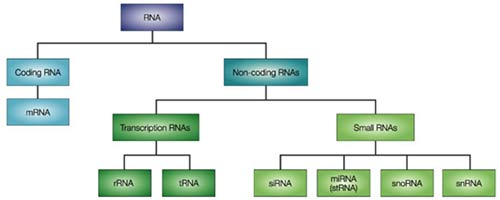
Diagram of relationships between different types of RNA. (Photo: Nature.com)
"The community of scientists is working hard to understand the special biological functions that microRNAs can work on," said Andrea Ventura, who leads the research currently working on postdoctoral research. at the Cancer Research Center (Cancer Research Institute Koch) of MIT.
Venture is also the director of Koch Institute and a member of the Tyler Jacks laboratory and her colleagues have studied the microRNA function known as the miR-17 ~ 92 group.
Previous research has shown miR-17 ~ 92 can be enhanced in some types of cancer, especially in the form of lung cancer and white blood cell cancer - B cells (B cells).
B cells are type B cells available in white blood cells, along with T cells, which are responsible for protecting the body from invasive bacteria or strange antigens . Although both types of cells can develop into cancer cells, B-type lymphoma is more common than T-cell type. In non-Hodgkin lymphoma, type B cells accounted for 85% and T cells accounted for 15%. B and T cells have different tasks in the body's immune system. B cells help protect the body against germs such as bacteria or bacteria by producing antibodies. These antibodies cling to the shells of bacteria or bacteria, and attract other cells of the immune system to envelop and digest the bacteria or bacteria that have been clung to antibodies. These antibodies also attract some blood proteins that can destroy germs.

The research team demonstrated that microRNA plays a role in maintaining normal development in mouse embryonic cells.From right to left, Amanda Young - biology graduate student, Monte Winslow postdoctoral researcher, Laura Lintault - laboratory technician Tyler Jacks and Andrea Ventura - postdoctoral research student.(Photo: web.mit.edu)
To better understand the role of microRNA in various forms of cancer, the group studied their normal function. By breaking the microRNA chain, they are damaged and inactivated, leading to the role of microRNA isolated from the gene. Through observing possible clue effects, the team understood the role of microRNA when the tumor is overexpressed.
They found that when the activity of miR-17 ~ 92 in isolated embryonic embryonic cells died, the postpartum pups died faster, possibly because their lungs were too small compared to normal. The result is similar to type B cells (a type of immune cell), which die at the early stages of cell development.
This suggests that miR-17 ~ 92 plays a decisive role in the normal development of lung cells and type B cells . In type B cells, microRNA seems to play a role in promoting the survival of cells by blocking the gene's cell purification activity, Ventura said.
The researchers hypothesize that when miR-17 ~ 92 is active in cancer cells, these cells will cope with the pre-programmed process for death to survive longer. .
Massively active microRNAs are considered a promising prospect in cancer treatment. The study is looking at molecules that block microRNAs that bind to target mRNAs.
A lot of new research is needed to produce reliable restraints & decay with oral medication, which is possible in the distant future, Ventura said.
Exactly, scientists still do not know which genes are governed by miR-17 ~ 92, but the most suspected gene is called Bim, which promotes the process of dying cells. However, a single microRNA can target many targets, so it seems that many genes are controlled by microRNAs.
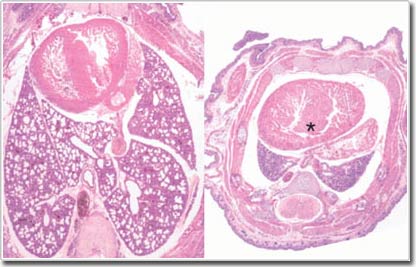
The left picture shows that the lungs in rats develop normally.The right picture shows atrophy of the lungs when isolating the activity of the microRNA group from the genome, resulting in rapid death of the pups after birth.(Photo: web.mit.edu)
The researchers also learned about the effects when isolating two other microRNAs, having them close to miR-17 ~ 92 but located elsewhere in the genome. They found that when only isolating these two microRNA groups (the miR-17 ~ 92 group was not interfered), the mouse embryo still developed as usual. However, if miR-17 ~ 92 is isolated with any one of the other two RNA groups, the mouse embryo will die before birth. This suggests that there are synergistic effects among microRNA groups.
The co-author of this work is biology graduate student Amanda Young; Monte Winslow, postdoctoral research student at Cancer Center (CCR); Laura Lintault, CCR member; Alex Meissner, lecturer at MIT & Harvard Institute; Jamie Newman, graduate student in biology; Denise Crowley, a member of CCR; Rudolf Jaenisch, a biology professor and member of the Whitehead Biological Drug Research Institute; Phillip Sharp, professor at MIT; and Jacks, biology professor.
The research was funded by the National Institutes of Health & National Cancer Institute (USA).
Nam Hy Hoang Phong (Translation & caption by Anne Trafton, MIT News)