People with this disease also face many problems such as short stature, missing part of the skull, and respiratory failure.
Corey Bennett , who lives in Indiana, USA, has become a famous name on the Internet recently. The reason is that Corey can perform a series of special actions such as clapping with both shoulders, crushing beer cans with his shoulders or folding this part in half.
Rare genetic disease
Corey has a rare genetic syndrome called Cleidocranial Dysplasia (CCD) . According to the information he revealed on his Tik Tok channel with more than 500,000 followers, Corey has no collarbone (clavicle) . In addition, the young man also has underdeveloped cheekbones, short stature, and hearing loss.
Craniofacial dysplasia also affects the teeth, spine, skull, and legs of the patient. According to the NY Post, Corey also admitted that his teeth were quite ugly.
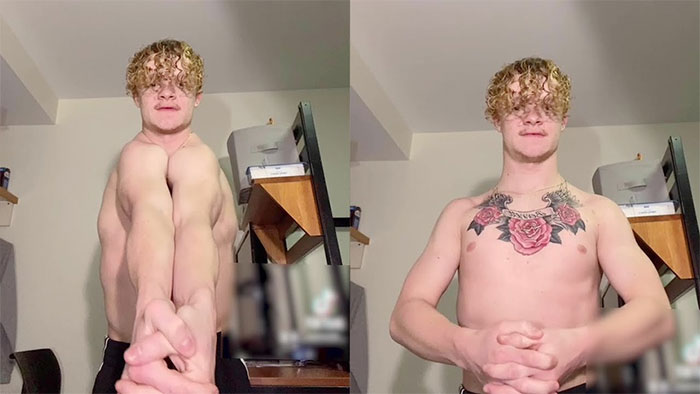
Corey Bennett can double his shoulders. (Photo: NY Post).
Sharing with LadBible, Corey confided that when he was a child, he was often bullied because of his strange illness. Therefore, Corey decided to do something different, which is to clap his shoulders, spread this and make his illness public to many people.
Immediately after posting these videos on social media, many people in similar situations contacted Corey. Hundreds of thousands of shares and comments with messages of sympathy. But Corey also received a lot of malicious and rude comments.
However, he insists that he will continue to make similar videos to help people around him understand the difficulties Corey faces when suffering from this disease. He also wants to spread a positive message to anyone facing a similar condition or suffering from a serious illness.
How dangerous is craniofacial dysplasia?
Corey is not the first person in the world to suffer from this syndrome. According to NBC News, in early February 2020, Stranger Things star Gaten Matarazzo had to undergo surgery to remove 14 extra teeth due to cranial dysplasia. Similar to Corey, the disease caused the 19-year-old star to be born without a collarbone and with extra teeth growing in his gums.
The first cases of craniofacial dysplasia were recorded in 1765. However, at that time doctors did not determine exactly what the disease was.
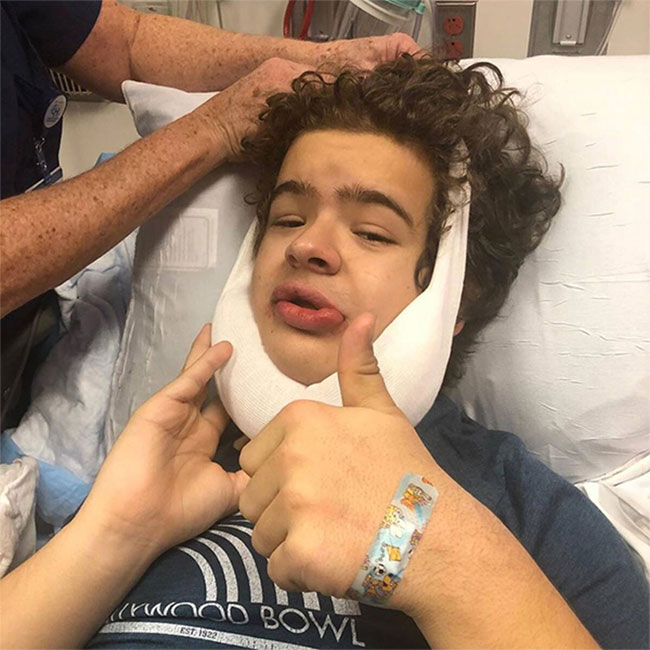
Actor Gaten Matarazzo is one of the few people in the world with craniofacial dysplasia. (Photo: NBC News).
According to the National Organization for Rare Disorders in the United States, craniofacial dysplasia is a rare disease with a rate of 1/1,000,000. World medical literature currently records a total of 1,000 cases of this disease. The disease is evident from birth, and affects men and women equally.
People with craniofacial dysplasia are characterized by short stature, abnormal facial features (high forehead, unusually wide face, small upper jaw), narrow, sloping shoulders due to missing collarbone. In addition, they also have a skull defect (fontanel), bulging skull cap, abnormally deformed pelvis, pubic bone, and chest area.
The patient's teeth grow slowly, some cases have cysts around the teeth that prevent them from growing or growing crookedly, cleft palate. They are short, have high palates, wide hip joints, unfused lower jaw joints, and uneven finger lengths.
Craniofacial dysplasia also leads to mandibular hypoplasia, which causes the hips to tilt to the right and the spine to curve.
Most dangerously, they are at increased risk of recurrent ear and sinus infections, upper respiratory complications, and hearing loss.
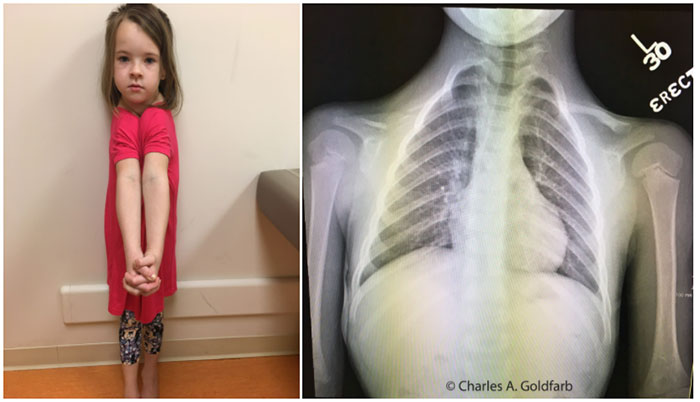
X-ray image of the clavicle bone of a patient with craniofacial dysplasia. (Photo: Charles A. Goldfarb).
According to Johns Hopkins Medicine, the patient has an abnormality when he has a mutation in the RUNX2 gene , found on chromosome 6.
This gene plays an important role in the formation of osteoblasts, bone-forming cells in the developing body; it also helps shape chondrocytes (which make cartilage) in adulthood. The risk of passing the abnormal gene from an affected parent to their child is 50% in each pregnancy, regardless of the child's sex.
There is no way to prevent or cure craniofacial dysplasia. Patients are forced to live with it for the rest of their lives. Depending on the problem they have, patients will be treated with orthodontics or surgery when necessary.
On CCD Smiles, a page dedicated to people with this condition, many patients share their experiences living with this rare disease.
Kyle (age and location not disclosed) started dental work at the age of 5. He underwent multiple surgeries and over 8 years of orthodontic treatment for misaligned teeth. After 24 years, Kyle has normal teeth. The man cried when he first saw his complete smile, without any misaligned teeth.