Cooking and cleaning up will become much easier if you know how to use your microwave oven properly .
Things to know when using a microwave oven.
- Useful tips for using a microwave oven that you should know.
- Things you shouldn't put in the microwave.
- 1. Foods with shells or membranes
- 2. Foods with low water content and high fat content
- 3. Water
- 4. Dried chili peppers
- 5. Grapes
Useful tips for using a microwave oven that you should know.
If you hate it when your pizza gets soggy, place the slice of pizza on a hot plate in the microwave along with a cup of water. The water will help the pizza slice become hot and crispy, preventing it from being chewy.
Worried about your eyes watering while chopping onions? Try poking a few holes in an onion and microwaving it for 30 seconds. This is said to help release the gases that cause your eyes to sting and water.

Water will help the pizza crust become hot and crispy, preventing it from becoming chewy.
There's an easy way to peel garlic: put the garlic clove in the microwave for 20 seconds. Be careful when taking it out, as it will be very hot, but this is also when the peel will be easy to remove.
If your food isn't cooked evenly, place it on the outer edge of the turntable in the microwave. This will help it cook more evenly.
If you're reluctant to peel and clean up after eating corn, you can cut off a few centimeters from the end of the cob and microwave it on high for 3-5 minutes. A gentle shake will then remove the kernels from the husk. Just be careful when doing this as the corn will be very hot.
If your microwave is heavily soiled, you can easily clean it with lemon and water. Take a bowl of water, squeeze some lemon juice into it, and microwave for 3 minutes. Then, leave the bowl of lemon water in the microwave for about 5 minutes before removing it and wiping the inside of the microwave clean.
Things you shouldn't put in the microwave.
1. Foods with shells or membranes
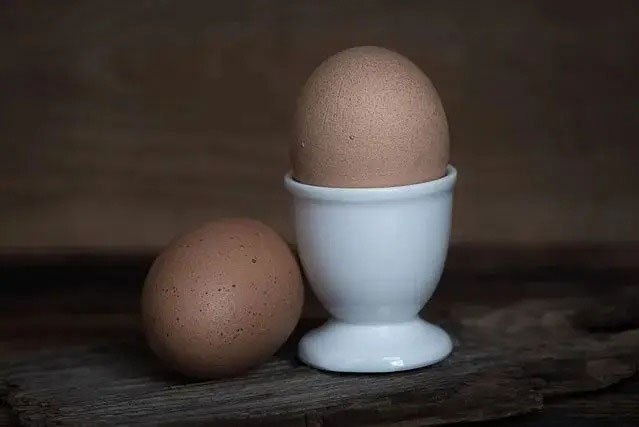
Eggs, sausages, fresh squid, and chestnuts with their shells are not suitable for heating in a microwave oven.
During the heating process, food produces steam. However, in foods with shells and membranes, this steam has nowhere to dissipate. Simultaneously, the increased internal pressure easily causes the shells and membranes to rupture, leading to explosions. Therefore, eggs, sausages, fresh squid, and chestnuts with shells are unsuitable for heating in a microwave oven.
If you absolutely must cook them in the microwave, you need to peel the shells and beat the eggs in a ceramic or glass bowl. You also need to make a few cuts in the outer shell of the chestnuts before cooking to allow steam to escape and prevent them from exploding.
2. Foods with low water content and high fat content
Microwave heating is primarily achieved through high-frequency oscillations of water molecules. When heating foods with low water content and high oil content, the food heats up because individual parts of the food absorb heat instantaneously, making it flammable and producing harmful substances such as benzopyrene, heterocyclic amines, and acrylamide, which also pose an explosion risk.
Therefore, skewers, bacon, sausages, beef jerky, dried small fish, and other dry and high-fat foods should not be put in the microwave for reheating.
3. Water
Microwave ovens cannot be used to boil water, especially pure water. To explain further, you need to understand that when boiling water in an electric kettle, the heating process is from the bottom up. When the water at the bottom reaches boiling point, many bubbles continuously rise to the surface, causing the water to boil.
However, microwave ovens heat all the water at once, without convection, causing the temperature to rise rapidly. But even at 100°C, the water doesn't boil. Water that exceeds 100°C without boiling is called "overheated water ," which is unstable and can easily cause burns.
Additionally, foods with high viscosity, such as separated milk or thick porridge, are not suitable for prolonged heating in a microwave oven, as they are prone to exploding.
4. Dried chili peppers

During the heating process, dried chili peppers are highly flammable.
Firstly, because the chili peppers are too dry and lack moisture, they easily catch fire during heating. Secondly, capsaicin and other chemicals produced by dried chili peppers after heating can irritate the eyes and respiratory system.
5. Grapes
Not only sliced grapes but also whole grapes will emit sparks when heated in a microwave.
This phenomenon occurs because grapes can absorb energy when exposed to microwave radiation. When this energy is released, it forms a strong electromagnetic field, which interacts within the grape. The energy of this electromagnetic field is strong enough to ionize the air and create sparks. That's why heating grapes in a microwave oven can create sparks and even cause them to explode.
But pears, apples, bananas, and other fruits can be cut into small pieces and heated in the microwave before eating.