According to the latest research, Neanderthal development was faster than that of modern humans.
This means that Neanderthal children may have matured physically at an earlier age than modern humans , thereby improving their ability to survive in the challenging environmental conditions of the Pleistocene epoch. .
These conclusions come from a study of Neanderthal baby teeth recovered from a fossil site in Croatia. The scientists determined these teeth had grown to be large enough to erupt out of the jawbone several months earlier than a typical child's teeth. The faster development of Neanderthals would have allowed Neanderthal boys and girls to start eating solid foods earlier, allowing their physical development to happen at a faster rate.
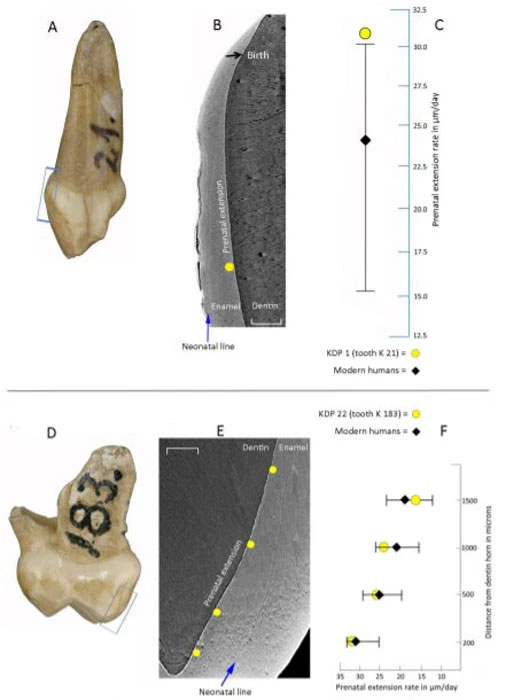
The baby tooth of a Neanderthal child.
Recent research, based on five baby teeth found at the Krapina site, Croatia, shows that the development of Neanderthal children was faster than that of modern humans.
As detailed in a paper published by Proceedings of the Royal Society B, an international team of scientists performed an extensive analysis of five baby teeth recovered from the archaeological site. Krapina Neanderthal in Croatia dating from the Pleistocene. This collapsed cave contains the fossilized bones of 80 dead Neanderthals, making it the most "populated" Neanderthal site found anywhere in the world.
Through dating methods, archaeologists have determined that the five baby teeth came from three Neanderthal infants between 120,000 and 130,000 years ago. They are intact and exceptionally well preserved, making them ideal platforms for this groundbreaking research.
"The relative growth rate of human and Neanderthal teeth is a hot topic. Some say Neanderthals evolved faster, but others say they fall within the range of human variation. " study co-author Helen Liversidge said in an article about the new discovery from London's Natural History Museum. Professor Liversidge is a dental anthropologist from Queen Mary University and a scientific associate of the Museum.
"This is the first time we've had Neanderthal baby teeth , so we're able to analyze and figure out the root development to see if they're coming in sooner, or later, " she explains. "We found that it appears that Neanderthal children's teeth would have grown faster and their baby teeth would have come in earlier than people today."
Liversidge and her colleagues took high-energy X-rays of five baby teeth to reveal more details about their structure and growth pattern. They tracked growth by measuring the enamel layers, which overlap on top of the crown as it grows. There is a special marker on the newly erupting baby tooth that shows how much it grew before birth and how long after, so you can accurately calculate the rate of tooth growth.
After analyzing the X-ray images, the researchers discovered that the incisors of Neanderthal children grew much faster than that of normal human infants. Infants' molars (back teeth) also grow faster and, as a result, they are better prepared to chew harder at an earlier age.
It appears that Neanderthal children developed teeth three to five months earlier than human children. This means their first teeth will come out of their jaws and become visible around 4 months of age, with the last teeth coming in at 7 months.

It seems that Neanderthal children develop teeth three to five months earlier than human children.
The faster tooth development of Neanderthal children suggests that weaning would take place earlier and a more varied and rich diet would also come sooner. Neanderthal children will have the same diet as adults, including red meat, seafood, mushrooms, and a variety of plant foods. This will support physical growth and brain development, allowing Neanderthal children to become more resilient and adaptable than Homo sapiens children of the same age.
This rapid development of Neanderthals may be related to the relatively short lifespan of Neanderthals. Previous studies have revealed that 85% of Neanderthals died before the age of 40. It was not clear whether the cause was extreme environmental conditions, susceptibility to disease, or genetic factors that caused the species to age rapidly. . It could be a combination of such factors.
Whatever the reason for their reduced lifespan, the Neanderthals would have had to reproduce profusely to keep their populations at a sustainable and livable level. Faster childhood growth means faster growth into adolescence and adulthood, which would have made it easier for Neanderthals to maintain a higher birth rate.

Neanderthals had a short lifespan.
The discovery of early Neanderthal tooth development is of great significance. But the question of the physics and evolution of species remains.
Helen Liversidge points out: 'It is difficult to say whether the Krapina specimens are representative of an entire species because we only have a few teeth. We will need more fossil samples to create a clearer picture."
The samples examined were limited in number, raising the possibility that Neanderthals living in different parts of Eurasia may have evolved differently.