Evidence of a human civilization thousands of years old was recently "rescued" on a South African coast .
Scientific breakthroughs can happen in the strangest of ways and places. Alexander Fleming discovered penicillin from mold growing on a Petri dish left out while he was on vacation. Chinese monks in the 9th century wanted to create an elixir of immortality: instead, they discovered gunpowder.
The remarkable discovery by a team of African scientists from Nelson Mandela University occurred on a rugged, remote stretch of coastline east of Still Bay on the southern coast of Cape Town, South Africa. It was low tide and three members of the fossil team were searching for the remains of Pleistocene vertebrates that had been recently exposed.
Ahead, they found a large boulder that had fallen from the cliffs above. On its surface was a pattern of straight grooves in the shape of a large triangle , complete with another nearly perfect median groove. The sides of the triangle were nearly 1 meter long.
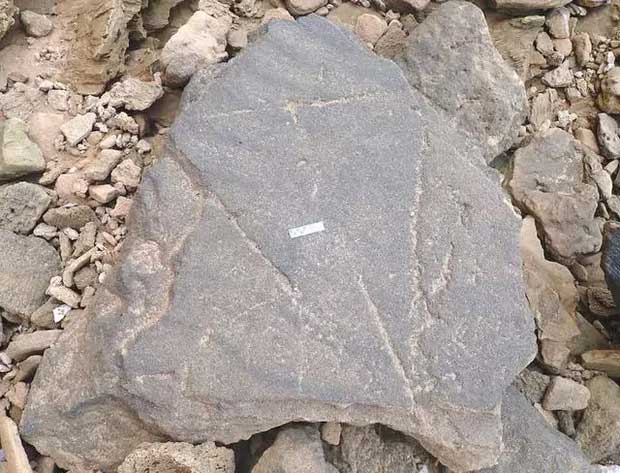
A large grey boulder surrounded by smaller stones and coarse sand. The large boulder has a triangular carving.
After extensive research, the team of scientists concluded that these grooves must have been created on the surface of the sand dunes by our human ancestors during the Mesolithic period . These patterns could be between 143,000 and 91,000 years old.
It is an important discovery in an important place. A wealth of evidence on this southernmost African coastline points to the area where our ancient ancestors began to spark civilization , using fire as a technological tool and creating abstract images.
But there was a problem. On a subsequent survey, they found a smaller rock nearby that had a similar triangular shape. However, it had been destroyed by the tide. Faced with the prospect of destroying the giant, intact 500kg rock, they set out to 'rescue' it.
After all, this is evidence of prehistoric "art" that our ancestors created long ago.
A "rescue" mission
Given the size and weight of the boulder, there was only one way to transport it: with a helicopter, a skilled pilot, and a sturdy net attached to a long cable.
The team raised funds through paid contributions to a book project. That money was used to hire a private helicopter and pilot, as well as send a ground team into the field on the day. They also sought permission from the heritage agency and the landowner.
It was a stressful process. The boulder could have broken as it was lifted from its cliffside position, or fallen into the sea. But September 29, 2022— 'Recovery Day,' as the team calls it—went off without a hitch.
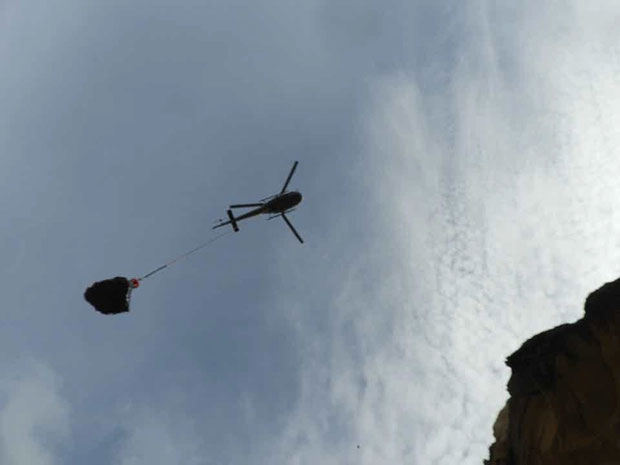
The rock was lifted by helicopter.
The ground crew and helicopter pilots worked together brilliantly. Minutes after being lifted from its remote location, the boulder was safely loaded onto a truck at the local airport. From there, it began a very careful journey to the Blombos Archaeological Museum in nearby Still Bay, where it was lifted and gently moved into place by dozens of volunteers.
The rock was later encased and put on display, with interpretive text panels. It joins similar exhibits in the museum; the grooves are an example of an ammoglyph , a term the team of scientists coined to describe a human-made pattern in the sand that is clearly visible on the rock after fossilization.
This discovery becomes important when we have clear evidence that people from the very earliest Stone Age had the concept of symbols or even geometry.