It may be with some people who look a little old-fashioned, or like a battery-powered device or it may be like a Roomba vacuum cleaner that Wilma Flintstone invented. But for Columbus 6th-graders in Bridgeport, the most bizarre thing about the animal wearing a cow's helmet and bumbling back and forth along the beach is not its appearance but its size.
A boy pointed to a pair of twins clinging to each other, the girl probably only has a width of 7 inches clinging to the tail part of her is much larger. Is the baby pig being carried by his mother on his back? The answer is no. Jennifer H. Mattei - Dean of Sacred Heart University Biology in Fairfield and expedition leader explained this phenomenon. They are all adults, one male and one female are bigger and stronger in the front.
Dr. Mattei explained that for adults, adult females are about 25-30% larger than males. This information may cause many girls to gloat and the boys are angry. Why are children bigger? The boy will probably ask that question. There must be some reason.
The answer to that question is closely related to the reason that Cheryl Crevier's students speak out loudly on a beautiful June morning on the coast of Long Island Sound. Holding a clipboard on his hand and a measuring tape wrapped around his neck, 22 children came to the coast to catch, measure and tag as many American as possible, or Limulus polyphemus - one of the ancient species. The most and the most compact on earth. Fossils found this year in Manitoba reveal that the body structure of samsara remains virtually unchanged within 445 million years.
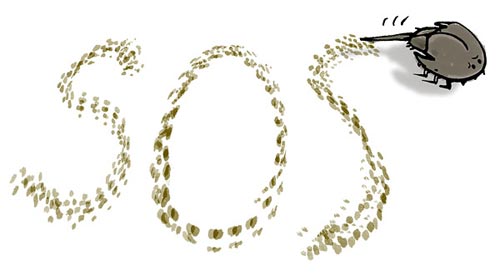
(Photo: Serge Bloch)
The students' trip was part of a major project conducted from Maine to Floria as researchers and volunteers raced to take advantage of the spring - the mating season of samsara. At this time they left the shelter at the sea floor towards the reef and went to the coast to breed, then they could count their numbers easily. Experts are anxious to know if their suspicion is correct about whether samsara is over-exploited as a bait to make the amount of sams decline.
The decline in numbers will be a tragedy, the researchers said, not only because these creatures are so cute and attractive, it appeared before the dinosaurs' time of about 200 million years but also because there are so many Many life forms must depend on them. The annual spawning season of sam attracts hundreds of migratory birds, predatory fish, reptiles, amphibians and many others looking for other food ready to rejuvenate the fresh, nutrient-rich Limulus eggs. Dr. Mattei said: 'Sam eggs are like soft beef. They are permanent items in the menu '.
At the same time, this is a very abundant supply. John Tanacredi - Dowling's professor of earth and ocean science in Oakdale, New York - says: 'A female pig produces about 80,000 eggs a year, and about 4 million eggs throughout her life.'
We humans are also highly dependent on these ancient undersea inhabitants. We extract a protein in their blood - a specific bacterial toxin-sensitive protein used to test surgical procedures as well as intravenous pharmaceutical testing to ensure safety. . In addition, the relatively simple sight of sams makes them an ideal model system to decipher the nature of vision."With only the eyes of a pig, we can predict which nerves in the retina will send signals," said Robert B. Barlow, professor of ophthalmology at Upstate State University University of New York. brain when receiving images'.
Columbus students after being reassured that the samsara was harmless, were helped to shed their fear when holding something that turned it up like a big scorpion or a spider. more like a crab like Dungeness crab, the children finally do the work with great pleasure.
They carefully scooped the sams away from the water and took them as instructed, as easily as holding a soup bowl. The children then poked small holes in the hard chitin shell of the pig with a tool made by Dr. Mattei and his colleagues Mark Beekey and Barbara Pierce. Before the blood seeps, the children will install a white numbered card. The blood of the sam is very special because it is green, because it has copper in the blood as an oxygen transporter instead of iron as in our blood.
When they did the work, the children learned about the pig, they used the tail like an ice breaker to turn the water, to return to a normal position when being turned over in the sand, why are they one species is ready to eat plankton, fish and worms, why they do not have jaws to chew but can crush food through hard spines on their legs or why their inner throat contains sand and gravel .
Dr. Mattei explained at high tide, solid snakes are considered real estates. 'There are over 20 species of creatures that live on the shells' , including oysters, green mussels, sponges, flatworms, leeches - the parasite species do not benefit the sams, but they do not often do harm it.
She described the life cycle of the sam. Animals must molt about 17 times to reach adult size when they are 9 years old. Males after the last molting get a special 'boxing glove' at the front. They often use these gloves to carry out the important task of sticking to the tail of a female, each time for several months. When combined, males and females do not mate. But every time the female lays eggs, the male has a favorable position to fertilize the egg.
'Females are larger than males to serve their eggs' function. In contrast, male sperm are like spider silk. Rarely does a war take place between two males. 'Whoever comes first will win'. This is a reproductive strategy that may compensate for the tiny.
But sometimes there are those who come first, who are big hot-blooded squirrels with healthier ones. In the last few years, the Asian market traded North American eel and conch meat grew very quickly, making the existing ones become the ideal bait. Even healthy female samsms cannot survive if all of their eggs are in the fisherman's basket.