In 1522, humans completed the first circumnavigation of the world by sea.
Many people believe that the explorer Ferdinand Magellan performed this feat. But in fact, he only contributed greatly to the historic voyage, while Juan Sebastián Elcano , a member of the fleet he commanded, completed it .
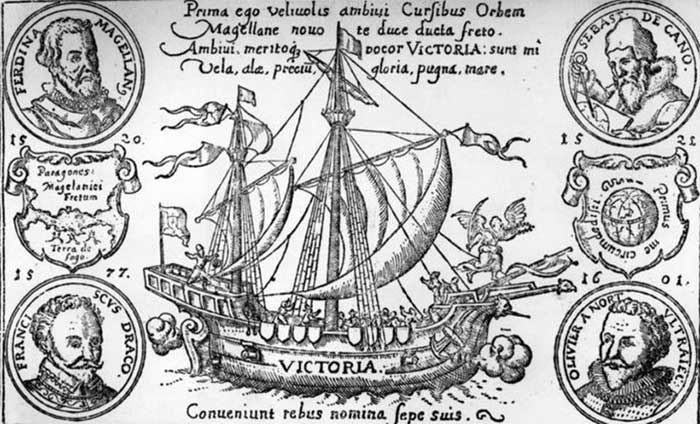
Engraving of the ship Victoria from 1580, with portraits of Ferdinand Magellan (left, top) and Juan Sebastián Elcano (right, top).
Join the expedition team
Juan Sebastián Elcano was born in the port of Getaria, in the Basque Country, on Spain's north Atlantic coast. Many believe he was born in 1476, but a more recent document puts it in 1487. He came from a well-to-do family, had eight siblings, and was well educated.
Young men in Getaria at that time often made their living by fishing and whaling, sometimes traveling as far as the cod-rich waters off Newfoundland. It is likely that Elcano did this as well, since he had the experience and the money to buy a 200-ton ship.
Historians speculate that something went wrong in business, forcing Elcano to sell the ship to the Italians, which was illegal at the time. Years later, when Elcano became a national hero, King Charles pardoned him. It is thanks to this pardon that historians learn some of Elcano's life as a shipowner.
Perhaps out of business, in 1519 Elcano joined the Concepcion as first mate, one of five ships ready for a long and dangerous voyage under the command of Ferdinand Magellan, a Portuguese native.
The mission of the fleet was not to circumnavigate the world, but to overthrow the maritime trade dominance of Portugal, Spain's economic rival. Magellan's plan was to find Spain a westward route to the Spice Islands, famous for their spices.
The Death of Magellan
The fleet set sail from Seville on August 10, 1519. Sailing westward toward South America, Magellan sought a waterway that would connect the Atlantic Ocean with the other great ocean. However, after several days, frustration soon overtook the expedition, leading to tensions between Magellan and the Spanish crew. A mutiny broke out in the Patagonian port of San Julián.
The two captains turned against Magellan, and Elcano—as Concepcion's first mate—joined in. Magellan eventually prevailed, executing the two mutinous captains and hunting down another leader who had fled. He did not execute Elcano, but stripped him of his rank and reduced him to a crewman.
In November 1520, having lost two ships - the San Antonio which returned to Spain on its own initiative and the Santiago which sank, Magellan and his remaining crew became the first Europeans to enter the Pacific from the Atlantic, after rounding the tip of South America.
Crossing the Pacific, they reached the Philippines, where in April 1521, Magellan was killed in a skirmish with the people of Mactan. A few days later, the king of Cebu, who was considered an ally by the Spanish, invited the surviving captains of the expedition to a banquet and suddenly massacred them. Elcano, due to his low status after the mutiny, was not invited to the banquet, and he survived.
After the massacre, the crew of about one hundred men escaped on the Trinidad and Victoria, while the Concepcion was sunk.
Journey around the world

Juan Sebastián Elcano, engraving from 1791.
In September 1521, Gonzalo Gómez de Espinosa was elected commander of the fleet and captain of the Trinidad, and Elcano became his second-in-command, in charge of the Victoria. They finally reached the Moluccas in November of the same year.
In the weeks that followed, Elcano and Espinosa concluded treaties with the kings of nearby islands and prepared for the long return journey. While loading, a serious leak occurred on the Trinidad.
So they agreed to separate, with the Victoria sailing west to Africa, and the Trinidad, after repairs, sailing east to Panama. But the Trinidad then ran into trouble, had to return to the Spice Islands, and was eventually destroyed.
On December 21, 1521, the Victoria weighed anchor. Under Elcano's command, the ship sailed southwest through the Malay Archipelago with a crew of 60. In February, Elcano entered the Indian Ocean, performing one of the greatest naval feats in history. It was the first time a European had crossed the giant sea at its widest point.
For months, without sight of land, the crew sailed the ship in fierce winds. Many died. After rounding the Cape of Good Hope, the crew became severely starved and thirsty, forcing the Elcano to stop at the Cape Verde Islands.
There, several sailors were taken hostage by the Portuguese forces. Fearing the loss of his precious cargo, Elcano quickly set sail. The weary crew finally discovered the southern coast of Spain in the fall of 1522.
Upon his arrival at the Spanish king, Elcano was presented with a shield bearing a globe bearing the Latin inscription 'You are the first to circumnavigate me'. Despite this great achievement, Elcano left very few records of his journey. Historians have only the report of his journey sent to King Charles upon his return and the answers to a questionnaire given to him by a court official.
Elcano never married and his two illegitimate children both died young. In 1525 he joined another expedition to the Moluccas and a year later, before reaching the Spice Islands again, Elcano died of scurvy . In a simple ceremony, his body was thrown into the Pacific Ocean, resting at sea.