Throughout human history, there has been a rather mysterious number that has fascinated many people. Through generations, from ancient times to the present day, many extraordinary minds have tried to calculate that number, only to find that they could only arrive at an approximate value.
Explore the history of transcendental numbers.
This number cannot be written as a finite integer, a fraction, or an irrational number. To date, it has been accepted as a transcendental number.
1. Definition
p = 3.141592653589793238462643383279.
-
Pi is the name of the
 sixteenth letter of the Greek alphabet. It is defined as a constant, the ratio of the circumference of a circle to its diameter.
 -
The name pi comes from the word peripheria (perijeria), meaning the circumference of a circle.
-
But it doesn't have a precise name; it's commonly referred to as p, c, or p.
-
The letter p was used around the mid-18th century, after Euler published his analytical treatise in 1748. The intention behind the symbol p was to commemorate the Greek mathematicians who were the first to find an approximate value of pi.
-
By the end of the 20th century, the number p had been calculated with an accuracy of up to the 200 billionth (200,000,000,000)th digit.
-
September 11, 2000: The one million trillionth (1,000,000,000,000,000) odd number is zero.
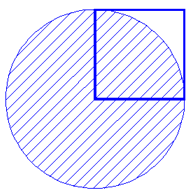
The simplest definition given to this famous number is: it is the ratio of the area of the circle to the square of its radius . For example, the area of the circle shown here is p times the area of the square.
The same number is found again in the calculation of the circumference of a circle, equal to 2p times its radius. As Archimedes observed, that number is used in both of these calculations. And it is not surprising if we encounter the same number here and there.
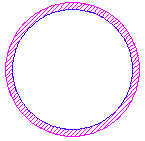
The area of the rim between two circles with nearly equal radii can be calculated in two ways:
- Subtract the area of the small circle from the area of the large circle.
- Since the radii of the two circles are approximately equal, the area of the rim is the product of the circumference of one of the two circles and the thickness of the rim.
2. Methods for calculating Pi
Approximate calculation.
The oldest method.
Draw a circle with
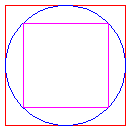 a radius of 1 unit and two regular polygons, one inscribed and one circumscribed around the circle.
If the regular polygon is a square, then the circumference of the circle will be between the circumference of the inscribed and circumscribed squares, meaning the value of Pi will be:
-
2
 < p < 4
 -
2,828 < p < 4
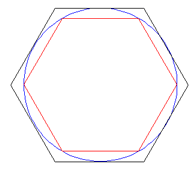 Increasing the number of sides to 6 gives us a better result: 3 (because the side of the hexagon is equal to the radius of the circle) and 2
 = 3.461.
-
3 < p < 2

-
3 < p < 3,461
When calculating the perimeter of polygons with thousands of sides, and dividing the result by the diameter of the circle, we find the most accurate approximate value of
 355/113.
3 5 5
1 1 3
Easy-to-remember numbers: the first odd numbers, two 3s, two 5s, two 1s, and the sum of the two numbers in the numerator and denominator that cross each other equals 6.

The Babylonians calculated the number p by comparing the circumference of a circle to the inscribed polygon within that circle, which is 3 times the diameter of the circle. They estimated it roughly as: p = 3 + 1/8 (i.e., 3.125)
Archimedes used a polygon with 96 sides and calculated the smaller (inférieur) approximation as 3 + (10/71) = 3.1408. and the larger approximation as 3 + (1/7) = 3.1429.
This means: 3.1408. < p < 3.1429.
To determine the value of Pi, one can try drawing a circle and a square of the same area using a ruler and compass. Then, using the same ruler and compass, draw a line segment of length Pi, and deduce the exact value of this number.
But this method of drawing is not possible: In 1837, Pierre Wantzel proved that one can only draw line segments with a ruler and compass when the length is an algebraic number, that is, a solution from an algebraic equation whose coefficients are integers, and in 1882, Ferdinand von Lindermann proved that Pi is not an algebraic number.
The number Pi is found in many other branches of mathematics.
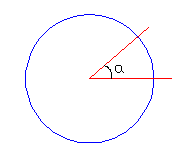 *For example, when measuring an angle, we must choose a unit by arbitrarily defining a full circle of 360 degrees. With the unit "degrees," the measurement would be 1/360 of a circle. If we use the value of one circle as 2p, the unit of measurement would be called a radian and its value would be 1/(2p). Measuring angles in radians has several advantages: for example, the length of a part of a circle bounded by angle α would be equal to ra when measuring the angle in radians, but if measured in degrees, it would be (2pra)/360.
* Similarly, the ratio (sinx)/x approaches 1 as x approaches 0 if we calculate angles in radians, but will approach 180/p if we calculate angles in degrees.
* Using radians to measure angles has led to the discovery of many properties of Pi. For example, according to Euler's theorem, the exponent of the complex number 2ip equals 1. Furthermore, from the results of using radians to calculate angles, Pi has been found in unexpected places: for example, in infinite sums (Leibniz series).
1 - (1/3) + (1/5) - (1/7) - . has a value equal to p/4.
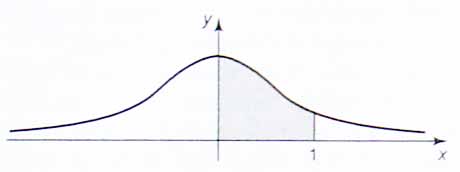
* Integration:
 This means that the area under the curve of the equation f(x) = 1/(1+ x2) between 0 and 1 is also equal to p/4. These two results are not difficult to explain because the tangent of the angle p/4 is equal to 1.
Pi also appears in the value of a sum.
1 + (1/2 2 ) + (1/3 2 ) + (1/4 2 ) + . equals p/6
Odd numbers of Pi
The number Pi encapsulates a history of ancient mathematics spanning over 4000 years, encompassing analytical geometry and algebra. Mathematicians have admired it since the time of ancient civilizations, and the Greeks, in particular, for its geometric properties. The oldest known and documented value of Pi comes from a tablet.
Later, continuous research was conducted:
* Archimedes calculated Pi = 3.142 with an accuracy of 1/1000. The formula is: 3 + 10/71 < Pi < 3 + 1/7
People have been using the Archimedes method for 2000 years.
* In the Bible, around 550 BC, this number was hidden in a sentence on an ancient Babylonian tablet (from Iraq) with cuneiform writing, discovered in 1936, and the tablet is 2000 years old. After many curious minds searched, the number Pi = 3.141509 was finally discovered.
Around 1450, Al'Kashi calculated Pi with 14 decimal places using Archimedes' polygon method.
That was the first time in human history that the number Pi had been found with more than 10 decimal places.
In 1609, Ludolph von Ceulen, using Archimedes' method, calculated Pi with 34 decimal places, a number inscribed on his tombstone.
It is impossible to calculate the exact value of Pi.
In the late 18th century, Johann Heinrich Lambert (1728-1777) and Adrien-Marie Legendre (1752-1833) proved that there is no fraction to calculate Pi.
In the 19th century, Lindemann proved that Pi cannot be a solution to an algebraic equation with integer coefficients (for example, y = ax² + bx + c where a, b, and c are integers).
* Following in the footsteps of Ludolph von Ceulen, thanks to the diligent research of mathematicians:
Newton (1643-1727)
Leibniz (1646-1716)
Gregory (1638-1675)
Scientists Euler (1707-1783), Gauss, Leibniz, Machin, Newton, and Viète searched for formulas to calculate the approximate value of p accurately. The simplest formula, discovered by Leibniz in 1674, is: p/4 = 1 - 1/3 + 1/5 - 1/7 + .
Carl Louis Ferdinand von Lindemann (1852-1939)
Srinivasa Aiyangar Ramanujan (1887-1920)
Williams Shanks (1812-1882) calculated the year 1874 with 707 decimal places.
It wasn't until the 18th and early 20th centuries that Pi was calculated with an accuracy of 1000 decimal places.
In 1995, Hyroyuki Gotu set the world record: finding 42,195 decimal places.
Where does the symbol π (Pi) come from?
According to the mathematician and historian Florian Cafori (1859-1930), the first person to use Greek numerals in geometry was William Oughtred (1575-1660). To denote perimeter , he used the Greek letter Pi (π). To denote diameter, he used the Greek letter Delta.
In 1760, William Jones (1675-1749), in his book Synopsis Palmariorum Matheseos, used the letter Pi (π) to denote the ratio of circumference to diameter of a circle.

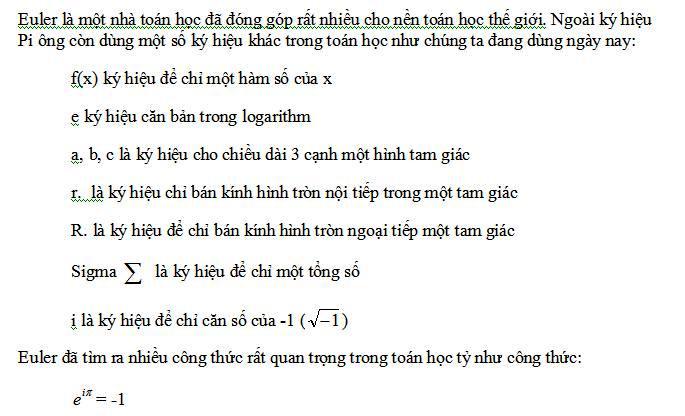
It was not until the renowned Swiss mathematician Leonard Euler that the symbol Pi (π) was widely used and universally accepted as the ratio of circumference to diameter of a circle; this was in 1748, as Leonard Euler wrote in his book *Introductio in analysin infinitorum*.
The fascination with mysterious numbers
The first hundred decimal places of Pi:
3,141 592 653 589 793 238 462 643 383 279 502 884 197 169 399 375 105 820 974 944 592 307 816 406 286 208 998 628 034 825 342 117 0679 .
Daniel Morin lists 2000 decimal places of Pi in http://platon.lacitec.on.ca/~dmorin/divers/pi.html
100,000 decimal places are listed on Yves Martin's page: http://www.nombrepi.com/pi100000.html
In 1995, Yves Martin used an EPSON laptop computer with a speed of 10 MHz to run the PIF.EXE program written in Pascal. The program ran for 1 hour, 28 minutes, and 33 seconds to produce 130,000 decimal places of Pi.
On September 19, 1995, at 00:29 local time GMT-04, Canadian mathematician Simon Plouffe, in collaboration with Peter Borwein and David Bailey, discovered a formula for calculating Pi that overturned some previously held beliefs about the number Pi.
This formula, named the BBP formula, allows for the independent calculation of the decimal places of Pi, whereas at the time, people thought it was impossible to calculate decimal places independently.
Fabrice Bellard, on Monday, September 22, 1997, set a record for calculating the one trillionth decimal place of Pi using Plouffe's BBP formula and his own research into a faster calculation method.
On Tuesday, February 1999, Colin Percival reached the forty trillionth decimal place using Bellard's formula.
September 11, 2000: The one quadrillionth odd number is zero : (one quadrillion = 1,000,000,000,000,000)
Now, with computers running thousands of times faster, Pi is only an approximation because that sequence of decimal numbers is still ongoing.