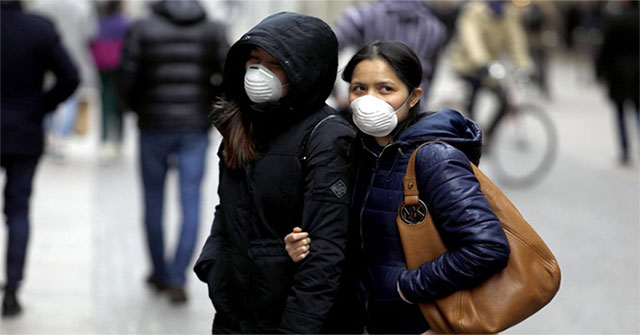
A number of health agencies have advised people not to use masks with exhalation valves, and airlines have even banned passengers from wearing them.
Face masks are currently one of the most sought-after items during the Covid-19 pandemic. You can also find many different types of masks on the market at different points of sale from pharmacies, supermarkets to labor protection stores.
But the truth is that not all types of masks are equally effective in preventing Covid-19.
While cloth masks and surgical masks have both been shown to be effective during the pandemic, there is one type of mask that experts and health authorities recommend you avoid: masks with exhalation valves .
Not only does it not prevent the transmission of Covid-19, this type of mask can even spread the virus further if the wearer is infected . Masks with exhalation valves have therefore been banned by most airlines in the US. They will refuse service to passengers wearing this type of mask.
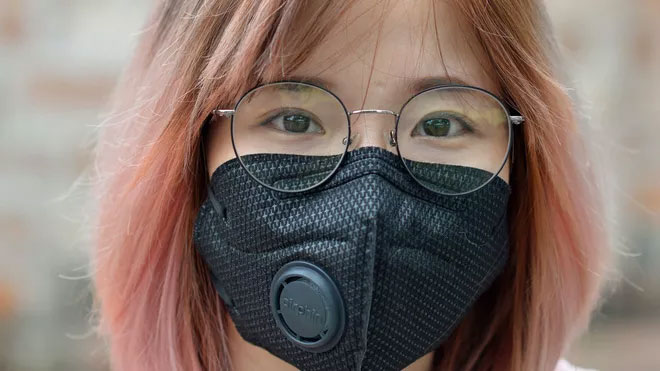
This type of mask does not prevent Covid-19, and can even spread the disease more strongly.
" The purpose of wearing a mask is to prevent respiratory droplets from the wearer from reaching others. However, masks with one-way valves or vents allow air to be exhaled through a hole in the mask. This can cause respiratory droplets to be expelled and reach others ," the US Centers for Disease Control and Prevention (CDC) said.
" This type of mask does not prevent the wearer from transmitting COVID-19 to others. Therefore, CDC does not recommend using masks with exhalation valves or vents for source control ."
Masks with breathing valves: Prevent dust but not prevent epidemics
Masks with breathing valves are often sold in labor protection stores, because they are specifically for industries that have to be exposed to a lot of dust such as construction, assembly work, house and road repair, etc.
3M is a well-known manufacturer of respirators, including N95 respirators equipped with exhalation valves. They describe how these masks work: Clean air is inhaled through the fabric filter. But exhaled air with moisture passes through the one-way valve.
The valve is essentially a thin rubber flap that is half closed and half open. When you inhale, air pressure from outside the valve pushes it tightly against the plastic cap. The inhaled air is filtered through the mask fabric. When you exhale, the higher pressure inside the mask pushes the flap open, and the air carrying water vapor is pushed out through the exhalation valve.
Masks with valves are therefore very suitable for dust protection, when you work at a construction site or go out on the street. It also limits the phenomenon of water vapor fogging your glasses. Unfortunately, this type of mask does not prevent the epidemic, and can even make the virus spread more strongly.
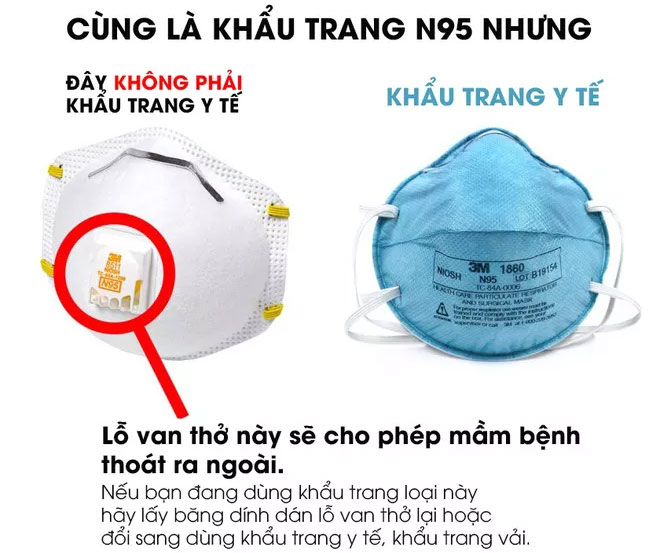
Both are 3M N95 masks, but the type with breathing valve is used in industry and has no medical use.
' Let's say you're an infected person and you're wearing a mask with an exhalation valve like this,' explains Rhonda Low, a family physician in Vancouver, Canada. 'When you exhale through the valve, your breath is being compressed through a smaller aperture. That means the droplets are being dispersed faster and can travel farther.'
A recent study in the journal Science Advances tested N95 masks with and without exhalation valves and concluded that the type with exhalation valves reduced the effectiveness of N95 masks.
'The filtration efficiency of N95 respirators is affected by the exhalation valve, which when opened allows a strong flow of air to the outside ,' the authors write. ' While this valve does not affect the ability to protect the wearer, it may reduce the ability to protect those around them.'
Meanwhile, health experts have repeatedly stressed that wearing a mask during a pandemic is more about protecting those around you than protecting yourself. Wearing a mask can help you block droplets from people nearby and avoid touching your face.
It does protect you to some extent. But the main purpose of a mask is to prevent your own droplets from spreading into the environment, carrying the SARS-CoV-2 virus with them if you are already infected.
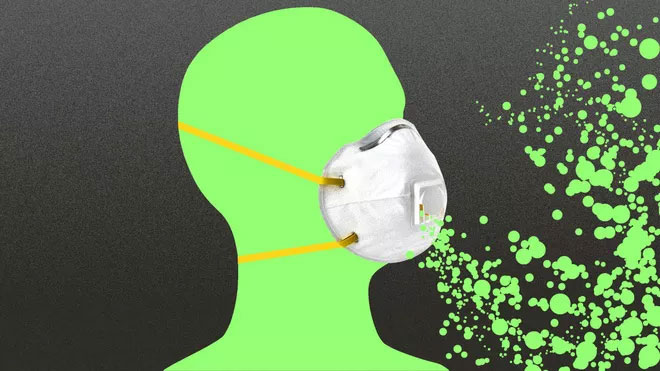
Masks with exhalation valves cause droplets to be dispersed faster and travel further.
According to the WHO and CDC, droplets from a person who is infected with Covid-19 sneezes, coughs, or even exhales are the main drivers of the current pandemic. And sick people can spread the virus even if they are asymptomatic and feel healthy.
A number of health agencies have advised people not to use masks with exhalation valves, and airlines have even banned passengers from wearing them.
As mentioned, the US Centers for Disease Control and Prevention (CDC) recently updated its recommendations for wearing masks during the Covid-19 pandemic. They emphasized that masks with exhalation valves are not effective in preventing the disease and advised Americans not to wear them.
People who are looking for an N95 mask with an exhalation valve because they think it's safer and easier to breathe through should switch to a cloth mask, the CDC says. A cloth mask can block most respiratory droplets from escaping.
Health Canada also said that masks with exhalation valves do not help prevent the spread of Covid-19. 'Some masks and respirators are marketed with exhalation valves that are intended to make the wearer more comfortable, but they also allow respiratory droplets carrying pathogens to escape outside the mask ,' they wrote.
" Using masks with exhalation valves will not protect others from Covid-19. Please do not use these types of masks or respirators."
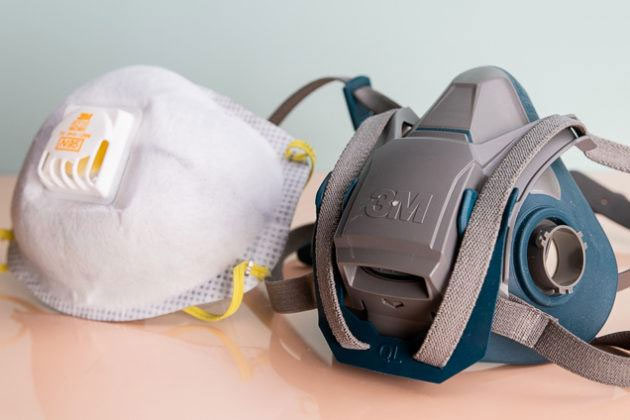
Even gas masks with breathing valves are not effective in preventing Covid-19.
Some people choose to use N95 masks or respirators with valves because they think it's safer for them. But Toronto Public Health says "these masks with valves only filter out dust, they don't filter out viruses."
Several Canadian cities have now imposed mandatory mask wearing orders when leaving home, and they have also stressed that masks with exhalation valves are not acceptable.
Several airlines in the US including Alaska Airlines, United, Delta, JetBlue, and most recently American Airlines have even refused service to passengers wearing masks with exhalation valves.
" Passengers traveling to or in the United States are not permitted to wear masks with exhalation valves, face coverings made of mesh or lace, face coverings that do not cover the nose and mouth, and face shields without a mask ," reads part of the new American Airlines policy.