Located in Bethesda, Maryland, the National Institutes of Health (NIH) is no different from a miniature city, with houses, supermarkets, clinics, parks . It gathers crystals Scientific flowers of the US and many countries around the world come to study human health.
City of researchers
From the center of Washington DC you can take the metro (metro) to NIH. After 20 minutes of being at the Medical Care metro station, right at the edge of NIH. However, it is not easy to get inside, you must let the security force check the bag, walk through the scanner and show the ID card (if it is a US citizen) or passport (if it is a foreigner). newly issued by the employee with a visitor pass (visitor card). If you take a private car, this car is thoroughly tested by military and security teams using electronic equipment to detect weapons or chemicals.
NIH was born in 1887, on the basis of a single laboratory of the Naval Hospital, but after 120 years it became a giant science center. NIH now covers more than 300 acres, with more than 18,000 employees working for 27 institutes and research centers in various areas of health from cardiovascular, respiratory, neurological, mental, and ophthalmological diseases, Child health, cancer, infections and allergies, to deafness / information disorders and alcoholism research . Each such unit is a high-rise building, scattered and separated. each other by dreamy parks.
To NIH, you must have a clear working address. The free bus runs all over NIH, dropping guests down where they need to go, so there's no going around. In fact, it is not good to want to go, because the area of NIH is too big, it is impossible to walk, and it is impossible to enter a building without a partner working down to confirm.
NIH's annual budget is $ 28 billion, of which 10% is for on-site research and 85% for external research or links with other partners. In 2007, seven Vietnamese scientists came to work at the NIH. And now two Vietnamese scientists are still participating in the NIH research, not to mention six others working in Vietnam.
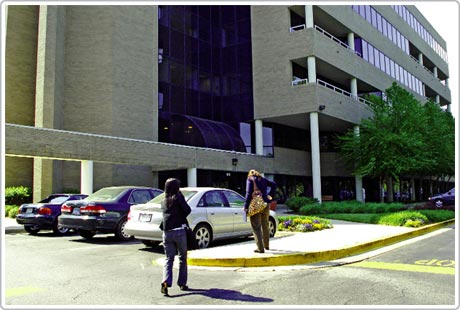
Behind this building are hundreds of scientists working hard to study measures to prevent influenza A H5N1.(Photo: PS)
'Knitting furnace' against bird flu
In the afternoon of July 7.5, Katherine Wagenblass - an employee of the International Center for Journalists, instructed me and colleagues of Lao Dong Newspaper to visit the Center for Allergy and Infectious Diseases (National Institute of Allergy and Infectious). Diseases - NIAID). Simply because we learn about bird flu, this place is the brainstorm of bird flu research activities around the world, including Vietnam. Mr. Karl A.Western, senior scientific advisor, said NIAID prioritizes research on tuberculosis, malaria, HIV / AIDS, biological defense, and vaccines. Researching the avian influenza in the department of infections and microbiology, has a research budget of US $ 135 million with 250 research projects in 60 countries.
Together with us, Dr. Polly R.Sager, talked about useful working trips on avian influenza in Hanoi, Ha Tay and Tien Giang over the past time. She is working on an interesting project, which is to learn about H5N1 seropositive status in people exposed to poultry. A hypothesis arises: is there the presence of antibodies in humans exposed to the less virulent H5N1 strain? If this is confirmed, after a while, these people can protect themselves against the more virulent H5N1 strain, like a 'natural vaccination'.
Dr. Sager's research will be carried out over 12,000 people in rural areas of Ha Tay, Thua Thien - Hue and Tien Giang. After two years, there will be results. According to Dr. Sager, these subjects were taken for blood, and they were compared to living habits, contact with poultry . From here, perhaps the medicine found a vaccine or Treating A H5N1 flu is no different from rabies-resistant serum!
In addition to this work, NIAID has many diverse studies on H5N1, such as understanding the development and transmission of viruses in many different animals, identifying signs of new virulent H5N1 strains, studying vaccine vaccines. influenza A H5N1 for people . Dr. David Cho, who presided over the influenza clinical research network in Southeast Asia, appreciated the cooperation of Vietnamese scientists with NIAID. He mentioned respectfully familiar names on the front of the epidemic front, such as Prof. Nguyen Thanh Liem, Nguyen Duc Hien (in the North), Tran Tinh Hien, Truong Huu Khanh, Vo Cong Dong (in the South) .
Phan Son (from Washington DC, USA, Saigon marketing)