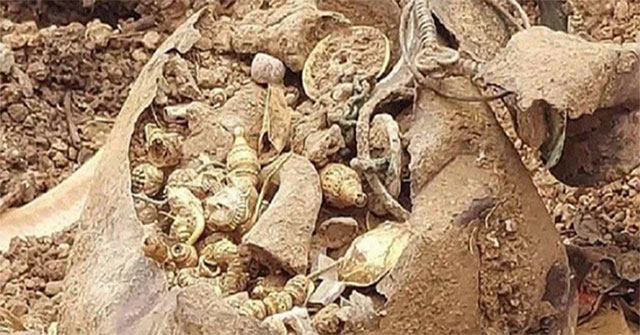
A strange white liquid suddenly leaked from the gap inside the coffin, experts hurriedly shouted and evacuated everyone from the tomb.
1,000 year old tomb on the cliff
In June 1985, while mining in a mountain quarry in Tongliao City, eastern Inner Mongolia Autonomous Region, workers unexpectedly dug up a stone wall.
At first they thought it was just a large rock and didn't pay much attention to it, but when they dug deeper inside, the workers discovered that the stone slabs were placed very regularly, with clear carvings.
Noticing signs of burial, the stonemason team quickly notified the Inner Mongolia Autonomous Region Archaeological Institute. After sending an archaeological team to investigate, the Institute said that these workers had dug at the exact location of the entrance to an ancient tomb over 1,000 years old, which existed during the Liao Dynasty.
According to Baike , this tomb is not simple but has a whole system of stone tombs with corridors, tomb chambers and left and right compartments inside, with a total length of 16.4m. Based on this elaborate design, archaeologists confirmed that this must be a royal tomb .

Diagram of ancient tomb in the mountain. (Photo: Sohu).
The archaeological team at the site were amazed to discover stairs built into the steep cliffs of Tu'erjishan Mountain, leading down to a spacious tomb chamber. There were buried a large number of gold and silver burial objects, lacquerware, pearls, agate, crystal, amber and precious silk.
Detect abnormalities
Along with the coffin, inside the tomb there are 200 relics, all of which are precious burial objects such as crystal cups, silver-plated saddles, golden bracelets, golden bells, crystal-handled daggers. and they are all very intact.
The most fascinating relic in the tomb is a blood-red cypress coffin , with elaborate phoenix carvings on top and very well preserved. The wooden base on which the coffin rests is also painted in a colorful color.

Two bodies wearing gold masks found in the tomb. (Photo: Sohu).
However, due to being buried under wet alluvial soil for a long time, most of the color on the coffin base is no longer there.
The archaeological team had to work together to open the extremely heavy cedar coffin and when the lid was slightly opened, two bodies wearing strange golden masks gradually appeared. The two bodies were relatively intact and wrapped in many layers of silk.
To protect the dignity of the deceased, experts did not immediately remove the gold mask. They decided to use the most advanced technology at the time to scan the body to determine more information about the tomb's owner.
As the archaeological team prepared to move the body to the research room, a strange white liquid suddenly leaked from a crack inside the coffin and flowed out more and more.
Upon seeing this, the experts quickly shouted and evacuated all the people present in the tomb. They managed to escape in time because the experts all knew that the Khitans had a custom of pouring mercury on the corpses to keep them intact. Mercury is very poisonous.
The large amount of mercury soaked in the coffins explained why these two thousand-year-old corpses did not rot. However, if a person accidentally inhales a large amount of mercury in the air, he or she can be poisoned or even have convulsions, leading to death on the spot, so the archaeological team had to immediately evacuate the area.
Finally, they decided to move the body to the museum to clean it and conduct DNA testing. The results of the DNA test report surprised scholars.
Identity of the tomb owner
Not only did archaeologists find a carved wooden coffin and many valuable burial objects, inside the tomb, they also discovered a stele typical of royal burial tombs.
Through the stele and documents of the History of Liao , the official history of the Liao dynasty (which existed from 907–1125), archaeologists determined that this was the tomb of Princess Liao Chen Guo of the Khitan dynasty , sister of Emperor Taizu of Liao.

The princess and her husband's costumes are on display at the Tongliao City Museum. (Photo: Sohu).
The princess died at the age of 18 and was buried with her husband-in-law, who was also her uncle (due to the custom of incestuous marriage in the royal family). Historical records do not specifically mention the reason for the death of the princess and her husband-in-law, only stating that they died of illness.
Liao History also clearly states that Princess Tran Quoc was a virtuous person, loved by the emperor and the people, so she was given a magnificent tomb.

The golden mask of Princess Tran Quoc. (Photo: Sohu).
When buried, both the princess and her husband were given golden masks, clearly carved with the features of the deceased's face.
Accordingly, wearing masks for the dead is a special custom of the Khitan people . This golden mask has the effect of keeping their faces dignified even when the facial parts have decomposed.
According to Sohu, the golden mask and burial objects in the tomb of Princess Tran Quoc are the first intact artifacts recovered from the Liao Dynasty. The artifacts have become historical treasures, helping to fill the gap in knowledge about a powerful dynasty that was once forgotten.
Unique treasure in 1,000-year-old tomb
According to experts, a total of 3,227 valuable burial objects were excavated from the tomb of Princess Tran Quoc.

The crystal cup was found in the tomb of a Liao Dynasty princess.
Among them was a glass cup with a gold chain. At first, archaeologists were both confused and excited because they did not expect a modern glass cup to appear in a thousand-year-old tomb. Some even thought that this object was left behind by grave robbers.
However, after careful inspection, the tomb showed no signs of being attacked by grave robbers and it turned out that the cup was made of crystal. The cup in the Liao Dynasty princess's tomb is considered a version of the Warring States period crystal cup (excavated in 1990) .

The Warring States period crystal cup was found in 1990.
This crystal cup is exquisitely crafted, with two small holes on the side of the cup to attach a gold chain. What makes experts even more amazed is that this treasure is still almost intact after nearly 1,000 years in an ancient tomb.
Making crystal objects is not simple. However, this cup was made with parameters similar to modern cups and glasses. It is clear that the technology of producing and making crystal objects in the Liao Dynasty had reached a high level, demonstrating the high intelligence and creativity of the people of that era.

This precious crystal cup is recognized as a national treasure and is on display at the Inner Mongolia Museum.
Although experts have yet to figure out how the ancients made this crystal cup, its discovery along with other valuable artifacts in the tomb of Princess Tran Quoc has great archaeological value and important significance for the study of the history of the Liao Dynasty.
The Liao Dynasty crystal cup was recognized as a national treasure shortly after its excavation. The "Crystal Cup with a Gold Chain " is currently kept and displayed at the Inner Mongolia Museum (China). After seeing this treasure in the museum, many people will surely believe that "time travel" is real.