Researchers from the University of California, San Diago (UCSD), medical school and Ludwig Cancer Research Institute have identified a group of proteins that form chromosomal bonds - formless, related to separation 2 identical copies of the genome during cell division.
They also identified a protein complex that helps distinguish between accurate or incorrect rhombic binding, and shuts down cell division when the link is incorrect to ensure that each cell has a set of Complete chromosome.
In a couple of articles in Cell magazine - an article published in the December 1 edition, and the second article published on December 15 - scientists report a solution to two mysterious mysteries. long on the genetic mechanism of the genome during cell division.
'These two discoveries have opened the door to further research into the link between chromosome and colorlessness, studies that could be beneficial for improving cancer chemotherapy therapy. ' - Dr. Arshad Desai, assistant professor of molecular and cellular medicine at UCSD and an investigator from the Ludwig Institute, who discovered the findings of both studies.
Cell division is a key issue in the development, maintenance and reproduction of all living organisms . During every cell cycle, the genome - carrying information of life - must be copied and arranged. Errors in the genome sequencing process result in genetic defects in reproduction and are the cause of cancer origin.
The exact division of the genome, when divided into several chromosomes varies depending on the species, requiring a specific protein sequence called acute rhombus.
'After the genome has been reprinted, the invisible rhombus forms a rhombic structure, the two rhombic bodies precisely concentrating half the copy of the gene before the cells contract in the middle to form. Desai said two new cells .
The chromosome is linked to the invisible shuttle chain during this time, and the interference in this link - using the drug to form an invisible shuttle chain - is a common chemical therapy for locating and shortening quickly. rapid cancer cell division. Although scientists know that disrupting this link can stop the proliferation of cancer cells, they still don't understand how the link is made.
By using an evolution in biochemistry, Desai and his colleague Lain Cheeseman, Ph.D., explained this mystery. In the article on December 1, they identified a protein group that formed chromosomal bonds - formless, present in even the simplest single-celled organisms, indicating its role in Genome sequencing is classic and conservative . The recognition of this group of proteins provides scientists with direction on new drugs in cell cancer.
'Currently, drugs used in chemotherapy chemically affect formless cells in the body's cells, causing adverse effects such as neuralgia and the loss of feeling' Desai says' If we can Accurate positioning of dividing cells, we can improve current chemotherapy to treat cancer with fewer adverse effects. '
The second article from the research group, published in the December 15 edition of Cell magazine, identifies a different type of link between chromosome and the invisible rhombus, which distinguishes between chromosome - invisible " accurate " and " incorrect "
Each mirrored chromosome consists of a pair of sister chromosomes, produced by the parent DNA branch cloning. This pair of chromosomes sticks together during the early stages of cell division. Once all chromosomes are completely boundless on the shuttle, the chromosome pairs dissociate and are pulled back to the two poles.
'Incidentally, both chromosomes connected to the same single end of the rhombic form have this ball, the result is: the daughter cell lacks an exact set of genetic information - a dangerous situation. because it can promote cancer deformation ' Desai said.
Cells avoid such fate by detecting errors in the formless binding process, breaking these shortcomings and overcoming it. But until now, scientists still do not understand how cells detect such errors.
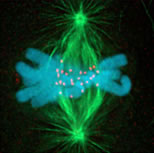 The ' dancing ' of chromosomes during cell division, first described in the late 1800s and is familiar with high school students from class biology films, has long been recorded smoking biologists.
However, the molecular nature of the key component in cell division, the ' chromosome-invisible chromosome ' linkage, determines the inheritance of genetic information when cell division is still difficult. understand.
Sharsti Sandall, a graduate student in UCSD's Biological-Pharmaceutical program, has identified a complex of two proteins that bridge the chromosome and chromatin, which is responsible for detecting errors in the submission process. This complex controls the activation of the kinase protein called Aurona (dawn goddess).
'A question arises: how did the bad cohesion be discovered' Desai said 'Our results suggest that the chromosome link and the spindle are invisible, including a kinase protein activator. , acting as a sensor in detecting bad attachments and arranging their presence in kinase activation " .
A protein kinase converts a phosphate group to target proteins to modify their properties. One of the goals of Auroca kinase activated is the protein group that makes the iron-spherical iron-bound link, determined by Cheeseman in the December 1 article.
Auroca's phosphorylation reduces the ability of this protein group to combine with chromatin. This explains why bad attachments are destroyed, promoting new directions until all the chromosomes in the cell are properly aligned. Desai's future goal is to discover exactly how the recognition complex by Sandall activates Aurora kinase for bad associations near it.
Ngoc Thanh