Scientists have discovered an exoplanet called Gliese 12 b in the constellation Pisces that has conditions suitable for life.
The team describes the discovery of Gliese 12 b in a paper published on May 23 in the journal Monthly Notices of the Royal Astronomical Society . The planet, slightly smaller than Earth and about the same size as Venus, has an estimated surface temperature of 42 degrees Celsius. That's warmer than Earth (15 degrees Celsius) but cooler than many other observed exoplanets, allowing liquid water to flow on its surface. The researchers speculate that Gliese 12 b could have an atmosphere similar to Earth or Venus, no atmosphere at all, or even an atmosphere unlike any previously known.
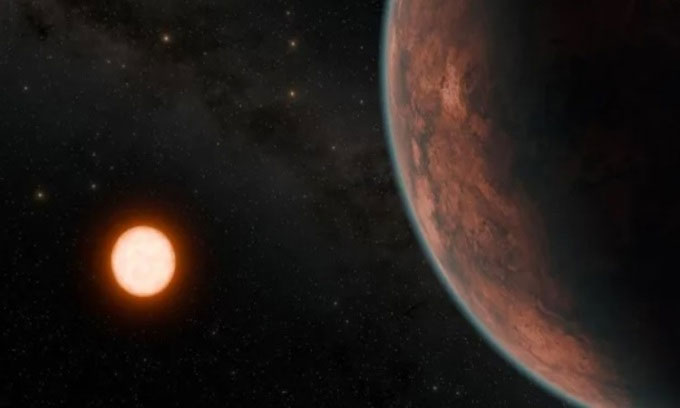
Simulation of the surface of exoplanet Gliese 12 b. (Image: NASA/JPL-Caltech/R. Hurt).
"Gliese 12 b is one of the best research targets to understand whether Earth-sized planets orbiting cool stars can sustain an atmosphere. This is an essential step in improving our understanding of the habitability of planets in the galaxy," said Shishir Dholakia, a PhD student at the Centre for Astrophysics at the University of Southern Queensland in Australia.
A key factor in a planet's ability to maintain an atmosphere is the activity level of its host star . Red dwarfs, like Gliese 12 , tend to be magnetically active, so they periodically produce powerful X-ray flares. Gliese 12, however, is not as active, increasing the likelihood that Gliese 12 b's atmosphere will remain intact.
"Earth and Venus' original atmospheres were lost and then restored through volcanic outgassing and collisions with other solar system bodies. Today, Earth has life but Venus does not. Because Gliese 12 b has temperatures between Earth and Venus, its atmosphere will tell us a lot about how planets evolved to be habitable," said Larissa Palethorpe, a PhD student at the University of Edinburgh and University College London.
Researchers discovered Gliese 12 b using observations from NASA's Transiting Exoplanet Survey Satellite (TESS). TESS has found more than 440 exoplanets to date. Gliese 12 b is among a small group of Earth-sized exoplanets that are temperate enough to be close enough to study their atmospheres in detail. Because Gliese 12 b receives about the same amount of light as Earth and Venus from the Sun, it is useful for filling in the gap between the two planets in the system, Dholakia said. Gliese 12 b could help researchers identify exoplanets with similar conditions to Earth, raising hopes for the potential for life on a temperate planet orbiting a cooler star in the Milky Way.