Nuclear techniques for treating diseases have been implemented in the world for 60 years. But in Vietnam, people have little knowledge of its benefits .
Mrs. TTKh. 54 years old - an overseas Vietnamese who came to Vietnam to visit his family. She is carrying hepatitis C and still adheres to the doctor's treatment. 6 months ago, she often felt tired, heart palpitations, palpitations. Seeing a new disease is another condition called hyperthyroid tumor (basedow). Now, the spirit of Mrs. Kh. collapse, weak health. She wanted to return to the US for medical treatment but was not allowed by the airline to board the plane.
In this case, if treatment with synthetic anti-thyroid drugs will often cause liver failure quickly, and if not treated, the arrhythmia, anxiety, dyspnea in patients will be worse.
Finally, doctors decided to use nuclear medicine to treat this patient. The patient was given a single dose of Iode - 131.
Six months after treatment, she said: 'I was very worried before that this technique had cured the disease and had an impact on health. After taking the medicine, I did not feel any discomfort, my health gradually recovered, my heart rate improved, there was no anxiety and fatigue like before. I came back here for a follow-up visit and a blood test, as a result, my illness was completely gone, the tumor was gone '.
Application of nuclear technology to diagnose and treat diseases has been implemented for about 60 years in the world. In Vietnam today there are about 12 facilities applying this technique in the medical field. In Ho Chi Minh City, there are 3 places: BV FV, Cho Ray Hospital and University of Medicine and Pharmacy. Dr. Nguyen Van Te-Head of the Department of Nuclear Medicine, FV Hospital said .
Radioactive substance into medicine to save people
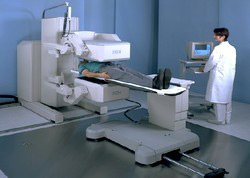 Application of multiplication techniques to treat diseases in hospitals.
Nuclear medicine is a medical industry that uses artificial radioisotopes to perform diagnostic imaging of organs in the body such as the thyroid gland, heart, bones, lungs, kidneys . called radiographs. . Or, use radioactive material to treat the disease.
This technique helps to investigate the functioning of organs in the body, early detection of lesions - something other diagnostic tools cannot do, such as examining the metastasis of cancer. bone.
Before the scan, the technician will inject radioactive isotopes into the patient's vein, then use a Gamma camera - a video camera to diagnose the function of the organs in the body, and then, depending on the possible use Radioactive isotopes for the treatment of diseases.
The injection of radioisotopes into the vein will be done before the recording from 20 minutes to 6 hours, sometimes recording immediately when injecting radioactive tracer depending on each agency to survey. When recording, the machine will accurately measure the absorption of radioactive isotopes, which will indicate the functioning of the agency to have an appropriate treatment plan.
Is radioactive substance dangerous to patients?
Radiopharmaceuticals do not adversely affect patients' health because the medical dose is very small with low energy gamma rays that are not toxic enough to cause reactions or allergies to users.
TREATMENT OF BASEDOW BY RADIATION
Hyperthyroidism is also called toxic goitre or Basedow disease. Diseases of the thyroid gland that are overactive if not treated promptly will cause serious complications that can lead to death such as cardiac arrhythmias, heart failure .
Currently, to treat Basedow disease, European - American countries are the preferred method of nuclear technology.
Treatment of goitre by this technique, the patient is not hospitalized, just take one dose of Iodine-131 in capsule form or as a solution. After drinking, the patient can go home immediately, then drink plenty of water and eat normally after 2 hours. In most cases, only one treatment is enough to heal. The cost for a goitre treatment is about 3 million VND.
* At present, in Vietnam, what medicine has been applied to diagnose and treat any disease?
- Diagnosis: each kidney function, find a place with pulmonary embolism, locate a diagnosis of neuro-endocrine tumors such as kidney medullary tumors, neuroblastoma and its metastatic positions . With Bone diseases, this technique reflects a very sensitive way of bone response to the pathology. Detecting secondary or primary lesions of bones, infection sores, sports accidents, osteonecrosis or pain dystrophy.
This technique helps to see clearly the bone damage from months before being seen on X-ray machines. For bone radiography, people first inject into a vein of a phosphonate patient marked with a technétium. In some cases it is possible to record immediately after the injection but usually about 3 hours after the radioactive tracer is attached to the bone and then it can be recorded. The recording time lasts from 5 - 16 minutes or longer depending on the case.
- In myocardial scintigraphy: help detect and locate myocardial ischemia in patients with angina, ischemic sequelae after exertion after myocardial infarction, follow one Known coronary artery damage, detecting the viability of myocardium after infarction, patients with diabetes mellitus.
- Thyroid scintigraphy: for images that reflect the state of iodine metabolism in thyroid cells, thereby helping professionals determine the appropriate treatment regimen for each thyroid or thyroid gland .
- Treatment: Currently this technique is being applied very effectively to treat thyroid diseases such as toxic goiter, thyroid cancer, adrenal adenoma, treatment of pain relief in bone-related metastases resistance to conventional pain relief therapy.
* Contraindications for which subjects? Do not do a scan for pregnant women. Drug radioactivity will be discharged through breast milk so breastfeeding women should stop breastfeeding within 48 hours after the scan.
Nhat Phuong