The fossil of a completely new species recently found in China has helped reveal the truth about one of the world's most terrifying monster families.
According to Sci-News, it was an extremely ancient ancestor of plesiosaurs , marine reptiles with necks even longer than the rest of their bodies.
The fossils, recently discovered from the Nanzhang-Yuan'an ancient fauna site in Hubei province, China, date back 248 million years, to the early Triassic period, the first era in the Triassic-Jurassic-Cretaceous period of giant reptiles.
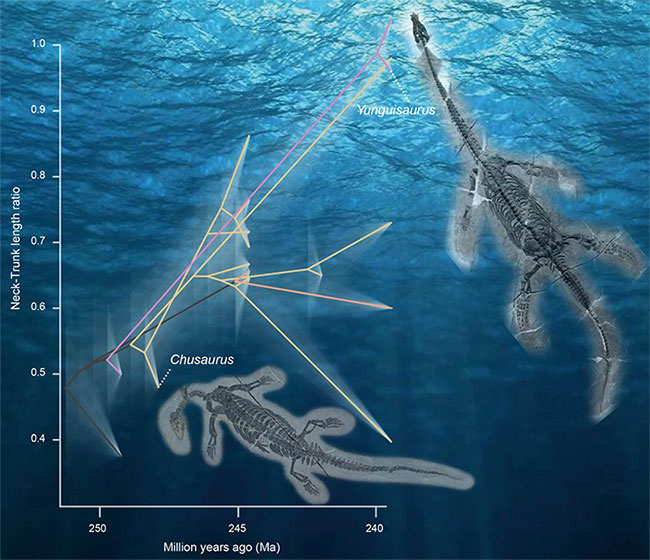
Diagram showing how ancestral monsters evolved extremely quickly to create the terrifying group of snake-necked lizards - (Photo: Qi-Ling Liu).
"The Early Triassic was a period of rapid evolution of marine life, following the devastating end-Permian extinction. This was particularly marked by the appearance of new animal species and new ways of life," explained Dr. Qi-Ling Liu from Wuhan University of Geosciences (China).
The ancestor of this snake-necked lizard, named Chusaurus xiangensis , belonged to the pachycephalosaur group and had a much shorter neck than its later "descendants", according to a paper published in the journal BMC Ecology and Evolution.
This group of monsters is also the connection that biologists have long been looking for: a group between the eosauroterygians - a group of short-necked marine reptiles - and the later pterosaurs.
Chusaurus xiangensis is the shortest-necked pachycephalosaur known, but clearly shows a trend toward neck lengthening in evolution.
Combined with fossils from the same group, it becomes living proof that the ancient lizards possessed a monstrous body thanks to the ancestors' necks growing longer with each generation, through the gradual addition of new vertebrae.
The longer neck becomes more flexible, allowing them to grasp prey gracefully like a snake while still maintaining a stable body.
With the appearance of what are now considered true plesiosaurs in the Jurassic period shortly thereafter, it is clear that this ancestral group evolved extremely rapidly, dramatically increasing the length of its neck, possibly stimulated initially by the harsh post-extinction world into which it emerged.