Having left the Institute of Chemistry to go to business, but the passion for research has led Duong Tuan Hung to return, with his colleagues to successfully manufacture steel and construction materials from red mud after alumina production.
Turn red mud into steel
The story of the doctor turned red mud into steel
In the last days of August, Duong Tuan Hung is busy with a new research project. Sharing about the passion for chemical research, the boy from Dong Anh (Hanoi) said it was a charm.
In 2004, while studying the last year of Chemistry, Hanoi University of Natural Sciences, Duong Tuan Hung was fortunate to win a scholarship from the Vietnam Education Foundation to become a PhD student at the University of Illinois, USA. Five years later, Hung returned to Vietnam with a doctorate when he was only 27 years old, mainly in analytical chemistry, solid physics and nanotechnology. The young doctor was admitted to the Institute of Chemistry, Vietnam Academy of Science and Technology.
"Due to studying in the US right after leaving the university lecture hall, having no practical experience in Vietnam, returning is a difficult time for me. The condition of the facilities as well as the surrounding environment makes I was disappointed in 2011. In 2011, I left the Institute to accept the position of assistant general manager of a construction technology equipment trading company in Ho Chi Minh City, " Hung recalls.
Although he has a high income, he always wonders, finds himself unsuitable for his business and thinks a lot about his previous education. While living far away from his family and having many minds, Hung met Dr. Vu Duc Loi, Vice Dean of Chemistry. Mr. Loi discussed with Hung on the topic that he and his colleagues are studying the technology of treating sludge, red mud to process steel and construction materials.
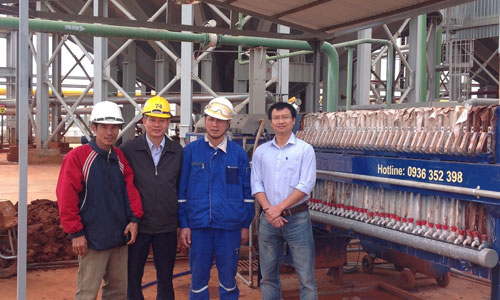
Young doctor Duong Tuan Hung, rightmost, and his colleague at Lam Dong alumina plant.(Photo: Character provided)
"I am very interested in this topic, the large amount of red mud released by alumina production threatens the environment is a huge risk. I want to go back to research so I decided to return to Institute of Chemistry in 2012" , Hung excitedly said.
With a budget of VND 13.5 billion, the group implementing the project "Research on technology of manufacturing unburnt steel and construction materials from the source of red mud in the alumina production process in the Central Highlands" has completed the project soon. more than half expected, in June 2014.
From the source of red mud, supplied by Vietnam Coal and Mineral Group, the research team together with Thai Hung Steel Plant of BCH Joint Stock Company (Hai Duong) successfully tested and produced on an industrial scale. some products. It is steel CT5 (more than 60 tons compared to the original plan of 30 tons), sponge iron (20 tons), refined iron ore (more than 100 tons, 90 tons used to produce sponge iron), unburnt bricks ( 3,000 tablets, 1,000 more than expected.
In December 2014, the research team was granted a Patent patent by the Department of Intellectual Property, Ministry of Science and Technology. After completing the study, the team handed over to the Executive Board to set up a feasible project to produce on a large scale.
Participating in the project at all stages, from the stage of writing the report to the component and technology research, Hung shared that the project has achieved the set objectives. However, the research team is still not completely satisfied with the performance of the production stage and needs further consideration to minimize costs.
At this time, Hung implemented the project: "Researching and manufacturing equipment for analyzing mercury traces for environmental monitoring and food control" . According to Hung, mercury is a highly toxic substance despite a small amount, the current status of heavy metal pollution will affect the environment and food chain, adversely affecting human health. Therefore, Hung Desire is able to create a compact device, which helps detect mercury accurately. Vietnam is acquiring equipment from Japan but not somewhat automated and rather bulky at high cost.
Talking about the current work at the Institute of Chemistry, Hung said that more colleagues are well-trained from countries such as the US, Japan and Europe. Besides, the leadership of the Institute also facilitates young scientists to promote their forte."Returning to Vietnam after studying with me is the right thing. I have been experimenting with new things and feel my contributions are valuable to the country. Besides, I also have the conditions to do so. many other meaningful activities, " Hung said.
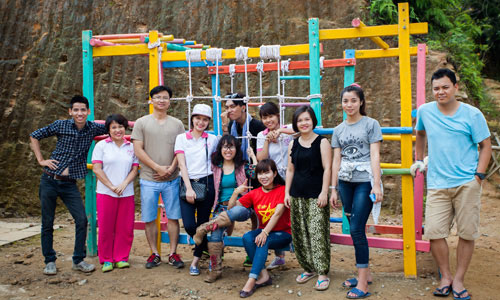
Duong Tuan Hung, third from left, with friends in volunteer group Working together on a swing in Phin Ngan.(Photo: NVCC)
Due to not having family problems, he is still single, so he spends a lot of time participating in activities of a charity group called "Co-Action" , donating funds to donate books, toys and school supplies to the children. small in many localities, including Phin Ngan commune (Bat Xat, Lao Cai).
When asked about his current salary, Hung offered nearly VND 4 million per month according to the State's rank and admitted "a little bit of anxiety" . With his expertise and degree in the US, Hung received some invitations from foreign joint ventures in Hanoi and a whole university in Ho Chi Minh City with much higher income. However, he only enlisted to do more, while the main time is still for research.
Although the infrastructure at the Institute of Chemistry is inadequate, Hung is more concerned about the activities for the research community. If you were in Illinois at the time of school, international, regional and international seminars were very exciting, now there are only one to two science activities each year. That makes young doctors like Hung feel less able to connect and communicate with people who do scientific research.
Looking further, Hung does not know what the orientation of the Vietnamese science industry is, although the Ministry of Science and Technology has many projects and events . "What areas does Vietnam need to focus on, to meet what needs? For example, what is my chemistry, developed for the purpose, developing in favor of biochemistry, chemical materials or petrochemicals? I hope that there must be more specific planning , " Hung said.