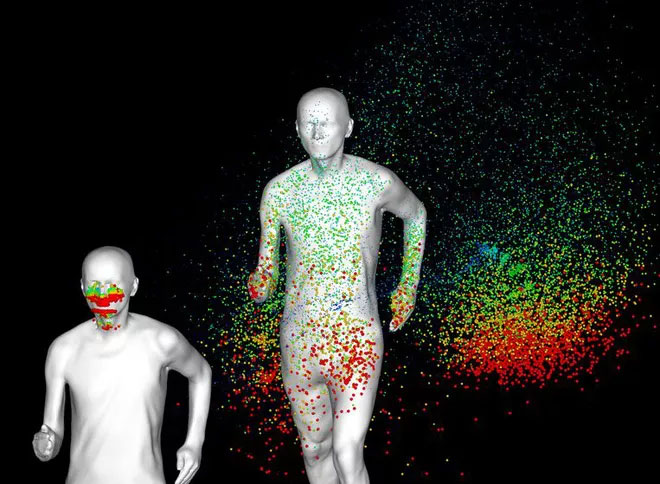
A simulation image is circulating on social media platforms like Facebook, Twitter and Reddit, implying that the coronavirus can spread beyond the 2-meter distance when you exercise with an infected person, specifically when you walk, run or cycle behind them.
This photo originates from a Dutch article, and a blog by a businessman named Jurgen Thoelen on Medium with the title: " Belgian and Dutch study: Why during the Covid-19 pandemic you should not walk, run or cycle behind another person".
Thoelen said he cited results from a " study " by KU Leuven University and Eindhoven University of Technology, which showed that people walking, jogging or cycling can inhale droplets from people walking in front of them even when keeping a distance of 1-2 meters.
But what is the truth of this " study "? Some scientists say it is not a scientific study, and that a businessman interpreting this " study " to the public has led people to misunderstand it .
A businessman misunderstood scientific research, thinking that walking and driving can also expose people to droplets from people with Covid-19.
A simulation gone wrong
The simulation videos were made by a team of four scientists working at KU Leuven University and Eindhoven University of Technology, led by Professor Bert Blocken, an engineer with expertise in sports aerodynamics and not a doctor, biomedical researcher or virologist.
" When you move, cycle or walk, you are actually creating a backflow of air, commonly known as a slipstream ," the Dutch newspaper quoted professor Bert Blocken as saying. " Usually in sports, the runners and cyclists [at the back] often take advantage of the slipstream of the person in front to go faster."
However, the slipstreams themselves will also spread clouds of droplets when the person in front breathes, coughs or sneezes. And the person behind them will risk inhaling them.
To assess the impact of slipstreams on people exercising together, professor Bert Blocken ran a computer simulation. And the results are as you can see in the video below:
Droplet cloud in the scenario where you walk at 4km/h.
The cloud of droplets is clearly visible, stretching behind the pedestrian, even at a speed of only 4 km/h. The largest droplets (red) are emitted when the pedestrian sneezes or coughs. But their breath also contains small droplets.
The red dots in the image represent the largest droplets. If you run through that cloud, they can still land on your clothes, says Professor Bert Blocken.
Based on his simulations, he recommends that if you choose to go out for exercise during the Covid-19 pandemic, walk at least 4 meters away from the person in front of you. The distance should be 10 meters if you are jogging with them, and 20 meters if you are cycling.
Jurgen Thoelen picked up on his idea and put it in his Medium post. Since then, the English version and the photo have gone viral on Reddit, Twitter and Facebook. And people feel like they shouldn't go out to exercise anymore, because the distances that Professor Bert Blocken recommends seem impossible in urban areas.
The author of the " study " has spoken out to correct the issue.
When he saw his simulation go viral with misleading messages, Professor Bert Blocken had to publish a "white paper" (which can be simply understood as a correction of misleading information in the media).
In a correction, Professor Bert Blocken admitted that his recommendations were based on aerodynamic simulations. Since he is not a virologist, Professor Bert Blocken is not sure whether you are at risk of contracting Covid-19 if you do not follow this principle.
His simulations were missing several variables, such as the rate at which droplets evaporate under outdoor temperature and humidity conditions, the ability of the virus to be killed by sunlight, or the viral load in droplets from people with Covid-19 who exercise. Often, people who are sick can still exercise, meaning they are asymptomatic or have mild symptoms.
In fact, Professor Bert Blocken has not published any scientific results from his simulations. Therefore, it is not a proof to recommend that people should not go out to exercise during the Covid-19 pandemic.
" Most people took the message in a positive way, but there were two misconceptions. One misconception is that we were making a virological claim. We were only testing the relationship between distance and contact with droplets.
It's aerodynamics : How will the droplets behave in the air flow? I'm not making any claims about whether the infection rate will be higher or lower ," Professor Bert Blocken told the Independent.
" Some people have said that I meant to advise them not to go out, run or cycle, which is the opposite of what I intended. I'm a veteran cyclist myself. People should go out, but they should be careful. If you're moving too close to someone, stay out of their slipstream."
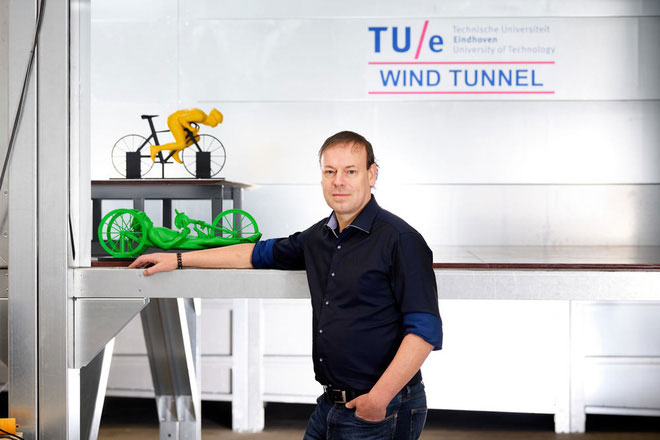
Professor Bert Blocken, an engineer with expertise in sports aerodynamics and not a doctor, biomedical researcher or virologist.
Professor Bert Blocken admitted that he had deliberately reversed the scientific publication process. He spoke to a reporter for a Dutch newspaper before his research was submitted for peer review, and even published it in a pre-publication journal, allowing other scientists to challenge it.
The procedure should have been done in reverse.
Some criticism from other scientists
William Hanage, an epidemiologist at Harvard's Center for Infectious Disease Dynamics, said that by reversing the scientific publication process, Professor Bert Blocken had a toxic effect on society.
That even got Hanage 'blood boiling .' Epidemiologists and virologists now show that the coronavirus is less contagious outdoors. Droplets from infected people carry the virus, but that doesn't mean everyone who comes into contact with a droplet will get sick.
Covid-19 transmission depends on a range of factors; scientists believe one of the most important of these is viral load, a measure of how many virus particles are in each droplet.
'In epidemiological terms, the location of the droplets is much less important than the viral load transmitted through that route ,' Hanage said. 'The advice about physical distancing really only helps REDUCE the risk of transmission rather than completely eliminating it.'
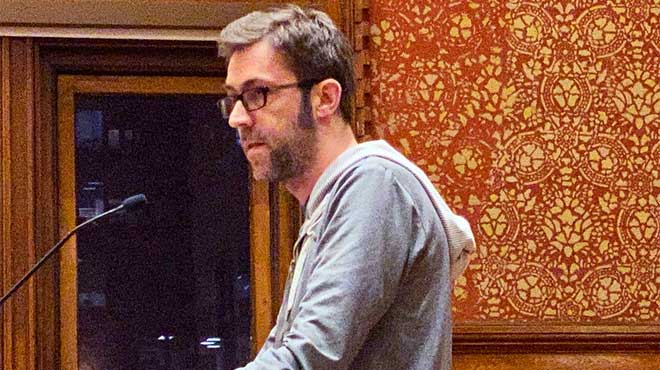
William Hanage, associate professor of epidemiology at Harvard's Center for Communicable Disease Dynamics, said Professor Bert Blocken's "study" was a piece of toxic information.
Hanage said that studies like Professor Bert Blocken's " are not really useful from an epidemiological perspective ." But it was widely circulated in the media, and people misunderstood it, so Hanage had to put aside his epidemiological research to warn about this " study ."
After all, scientific information in the Covid-19 pandemic always needs to be verified by experts, virologists and epidemiologists, instead of business people or researchers in other fields. Otherwise, it is very easy to misinterpret.